XBOW's $35M Round Is About the Cap Table, Not the Number
XBOW raised $35 million from NVIDIA, Samsung, Accenture, and SentinelOne with no financial lead. The shape of the round, not the number, is the signal.
By Tal Eliyahu · · 8 min read
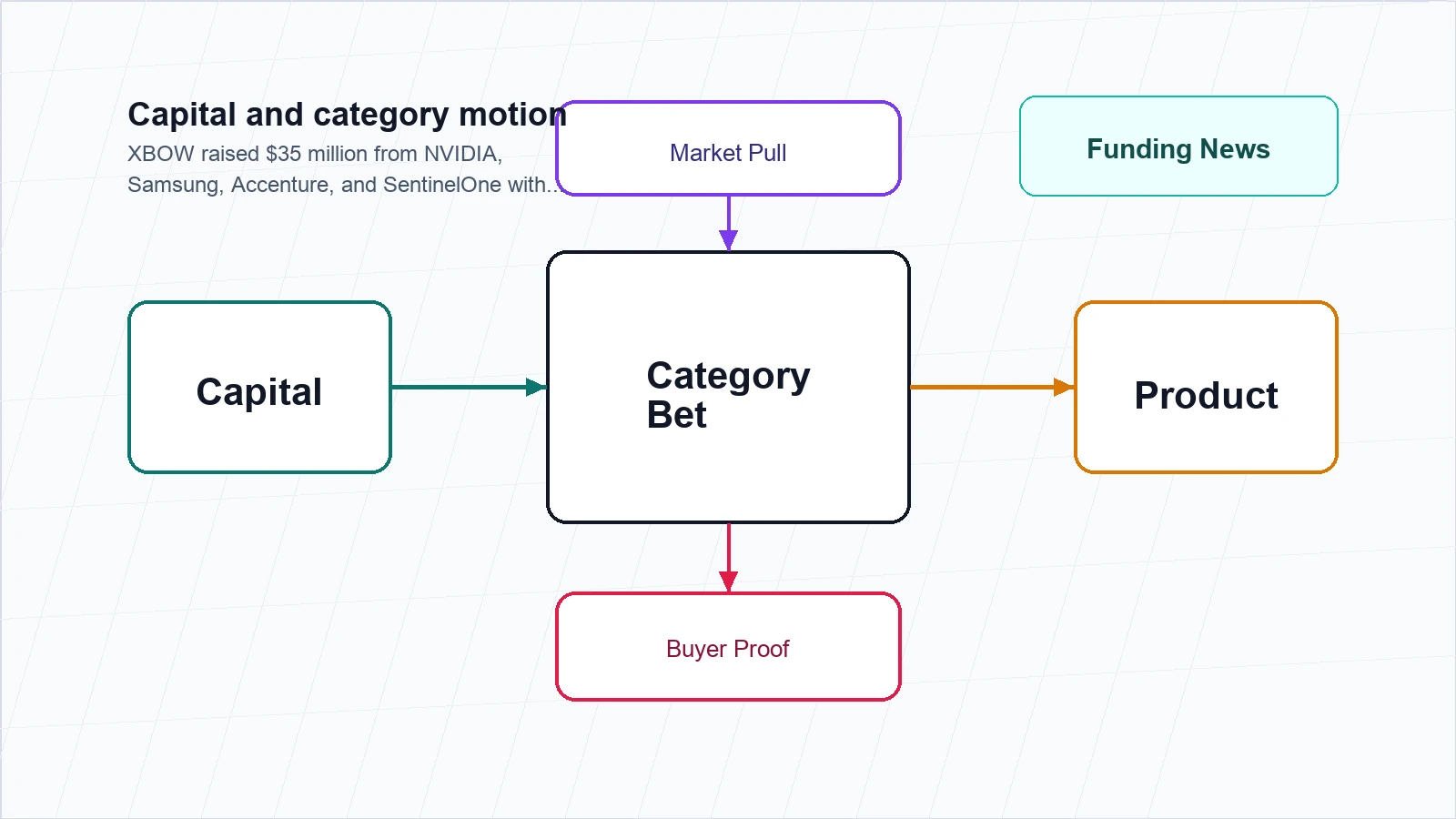
XBOW's $35 million Series C extension is the cybersecurity funding story of the quarter. Not because of the dollars. Because of the shape.
The whole round, closed on May 6, 2026, came from strategic backers: NVIDIA's NVentures, Samsung Ventures, Accenture Ventures, SentinelOne's S Ventures, DNX Ventures, and Liberty Global Tech Ventures. No traditional venture firm led. No financial lead at all. That is rare at this stage, and it tells us something about where cybersecurity AI capital is going that the headline number does not.
Many people will see $35 million and skip past the deal. Funding rounds in agentic security have started to blur — they all look big, they all sound similar, they all promise to automate scarce human work. The interesting thing about XBOW's round is that it is structured the way enterprise technology gets structured when buyers want a seat at the table. That is a different signal than another tier-one VC writing another check.
A round without a financial lead
XBOW operates an autonomous offensive security platform. AI agents probe applications continuously, the way a human attacker would, and surface validated exploitation evidence. The company was founded in 2024 by Oege de Moor — the engineer who led the team behind GitHub Copilot — and reached unicorn valuation on a $75 million Series B led by Altimeter Capital in 2025. With this extension, Series C now stands at $155 million and total funding crosses $270 million, per SecurityWeek.
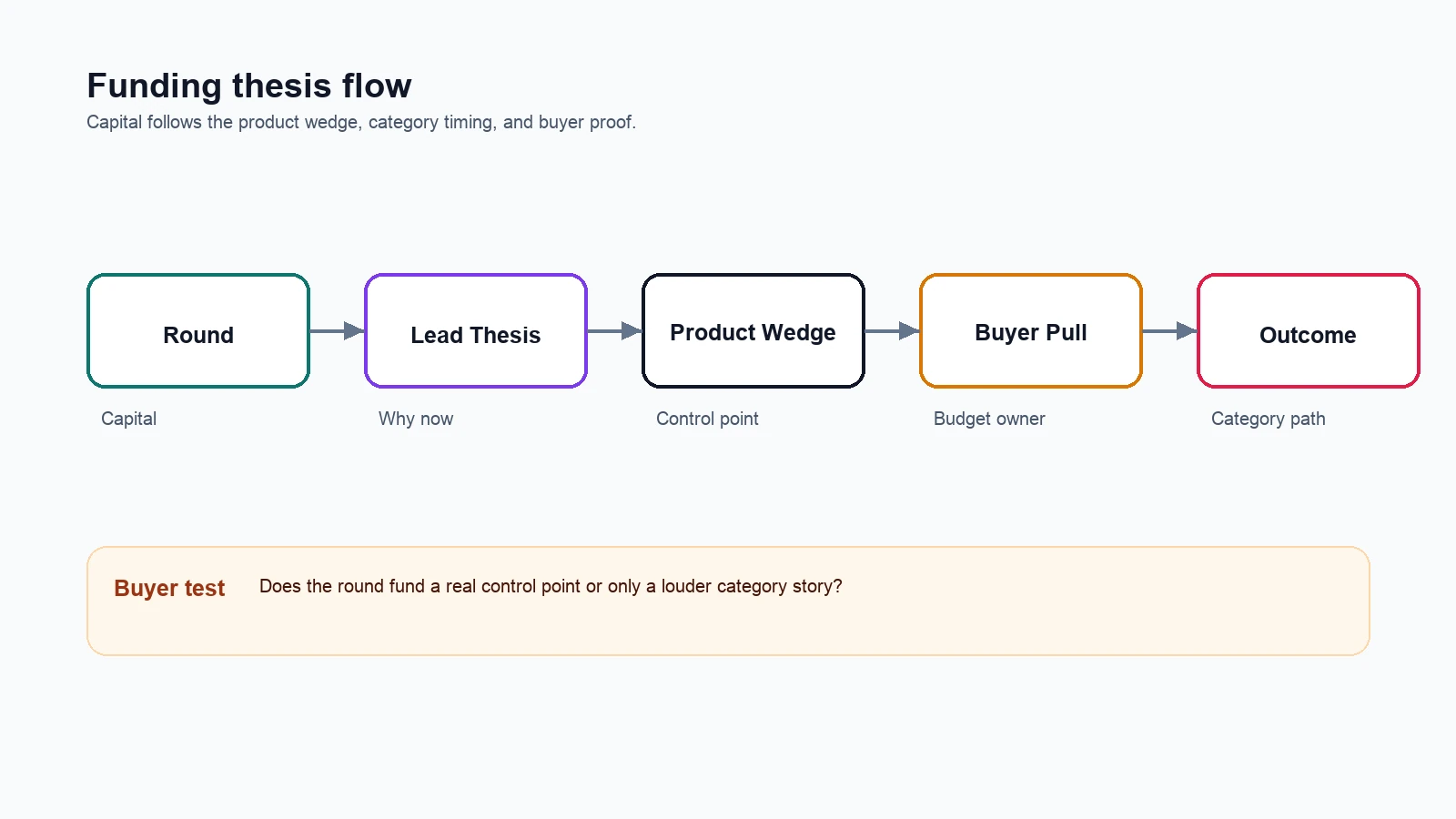
What is unusual is the cap table on this round.
Most late-stage cybersecurity rounds have a financial lead investor. The lead does the diligence, prices the round, and signals validation to the rest of the market. Strategics fill the remaining capacity. A strategic-only round flips that dynamic. The signal becomes commercial: every dollar in this cap table comes from a customer, partner, or distribution channel.
That structure is not an accident. It is what happens when a product has crossed from experimental to enterprise procurement. The investors are not buying optionality on a thesis. They are buying influence over a roadmap they already depend on.
Strategic-only rounds say something VC-led rounds do not
The companies that close strategic-only rounds tend to share a profile. The product is shipping at scale. Enterprise customers are renewing. Multiple competitors are being benchmarked head-to-head. And the strategics in the round are not pure financial bets — they are the customers, partners, and prospective acquirers preserving optionality on a category they expect to matter.
Read that way, the cap table is a leading indicator. SentinelOne investing in XBOW says SentinelOne thinks autonomous offensive security is going to matter. NVIDIA investing says NVIDIA wants visibility into where AI-security workloads run. Accenture investing says the managed-services channel is forming. Samsung investing means Samsung has interesting reasons of its own.
Cap tables don't predict acquisitions. They rehearse them.
Capital is concentrating in the categories that automate scarce talent
XBOW is one of several AI-native security companies to raise materially in the past month. Artemis raised $70 million in Series A for AI-vs-AI defensive security on April 15. Variance closed $21.5 million in Series A in early April for autonomous AI compliance and fraud agents. 7AI took $130 million in Series A for agentic SOC, the largest cybersecurity Series A on record.
The pattern is consistent across these deals. The product is AI-native, not AI-flavored — built around agentic execution, not retrofitted onto an older codebase. The target is work historically done by scarce specialists: pentesters, red teamers, SOC analysts, compliance reviewers. Series A check sizes are large because investors are paying premium for traction and category leadership. And strategic capital is showing up earlier in the cap table than usual.
Capital is not flowing to every cybersecurity sub-category at this pace. Endpoint protection rounds remain quiet. Network detection is consolidating. Traditional SIEM is in run-off. The disproportionate appetite is for *agentic security categories that automate work historically done by humans*. That is a structural shift, not a vintage-year fashion.
Procurement teams are picking platform leaders, not categories
For cybersecurity buyers, the practical implication sits in the procurement question, not the product comparison. The old question was whether autonomous offensive security is a real category. The new question is which of the three or four well-capitalized leaders to standardize on, and how to evaluate exploitation evidence across vendors that all claim continuous coverage.
The second-order effect is that the strategic capital base around AI-security leaders is starting to lock in distribution. NVIDIA's investment ties XBOW into the NVIDIA AI ecosystem story. Accenture's investment opens managed-services channels. SentinelOne's investment gives XBOW a public security buyer that could later become an OEM partner — or, more interestingly, an acquirer.
Architects evaluating AI-security tools should pick with care for which platform the tool will eventually live inside. Several of the highest-velocity AI-security startups are unlikely to remain independent past 2027.
The strategic cap table is now a credible path
Three things from XBOW's round are worth taking seriously if you are raising as a cybersecurity founder in 2026.
Strategic-only is now a credible path
The assumption that a tier-one financial lead is required to price the round is breaking down for AI-native security companies with enterprise traction. If your customers want roadmap influence and your strategic partners want distribution leverage, you can run a structured round with strategics alone. Your law firm has done it before for other companies. The mechanics are not novel.
Category framing matters more than category coverage
XBOW does not call itself a SAST tool, a DAST tool, or a pentest replacement. It calls itself autonomous offensive security. That framing is doing real work — it lets the company be priced like an AI-native category leader instead of being benchmarked against incumbent application security tools. Founders building agentic security companies should pay attention to the framing they choose. The framing sets the comparable set investors will use to value the round.
Where SentinelOne shows up matters
A public security buyer investing in a private AI-security company is a soft acquisition signal. SentinelOne has shown up in other AI-security cap tables recently. When public security companies start making strategic investments at this pace, expect those investments to translate into M&A within 18 months.
XBOW's round versus the recent agentic cohort
Against the past twelve months of cybersecurity Series A and B activity in agentic categories, the XBOW round is the cleanest expression yet of incumbent platform interest. 7AI's $130 million Series A for agentic SOC was the previous outlier in pure size. Artemis's $70 million Series A had a financial lead (Felicis) plus strategics. Variance's $21.5 million Series A had a financial lead (Ten Eleven) plus strategics. XBOW's extension is the first material 2026 round to land strategic-only.
In that company, XBOW's round is the one most directly tied to the platforms that will eventually buy these companies. Three of the seven investors operate or distribute security software at scale. That is not a financial-pattern round. It is an enterprise-procurement-pattern round.
NVIDIA's check is about runtime, not optics
The NVIDIA NVentures cheque deserves a separate read. NVIDIA does not need to invest in offensive security companies for distribution. The investment likely reflects two interests: GPU consumption from agentic security workloads, and reference architectures NVIDIA can publish as part of its enterprise AI stack story.
Agentic security platforms are GPU-heavy at runtime. Continuous probing of large applications, training of attack models on customer telemetry, and inference at the per-request level all push compute. If autonomous offensive security and agentic SOC become standard cybersecurity practice — and the procurement signals say they will — the underlying compute spend that flows to NVIDIA's enterprise customers grows materially. That is the pattern NVIDIA's earlier investments in cloud security, MLOps, and observability companies were positioning for.
The practical takeaway for security architects evaluating agentic platforms: ask vendors about their GPU runtime cost economics. The companies that can deliver continuous AI-native security at predictable infrastructure cost will outlast the ones that cannot.
The signals worth watching for the rest of the year
Three signals over the next 90 days will tell us whether XBOW's round was a one-off or a category pattern.
The first is whether other AI-security unicorns run strategic-only extensions. If 7AI or Artemis structures a similar follow-on, the pattern is real. The second is whether public security vendors expand their venture arms. CrowdStrike, Palo Alto Networks, and SentinelOne all have venture activity. If their cheque sizes step up materially in agentic categories, the M&A signal is firmer. The third is the pricing on the next agentic security acquisition. Cisco's Astrix deal in early May reportedly cleared $400 million. The next agentic security acquisition will set comparable pricing for follow-on M&A — and tell us whether strategics are willing to convert their cap-table positions into full ownership.
XBOW's round is small in dollars and large in signal. The next twelve months of cybersecurity capital allocation will be about which AI-native categories cross from venture-funded to platform-owned, and at what price.
Cap tables rehearse acquisitions before they happen. This one is not subtle.
Frequently asked questions
- Who is XBOW and what does the company do?
- XBOW operates an autonomous offensive security platform — AI agents that continuously probe applications for exploitable vulnerabilities the way a human attacker would. The company was founded in 2024 by Oege de Moor, who led the engineering team behind GitHub Copilot. The product replaces point-in-time penetration tests with continuous, validated exploitation evidence. That is a different procurement category than annual third-party engagements, and it is now being priced accordingly.
- Why does a strategic-only round matter in cybersecurity?
- Most late-stage rounds have a financial lead investor that prices the round and validates the deal. A strategic-only round means every dollar in the cap table comes from a customer, partner, or distribution channel — and the lead is, effectively, the market. The signal flips from thesis-stage validation to enterprise procurement validation. That is rare. When it happens, the cap table is functioning as a soft acquisition rehearsal, not a fundraising round.
- What does SentinelOne investing in XBOW signal for cybersecurity M&A?
- When a public security vendor writes a strategic check into an adjacent AI-security category, it is a soft acquisition signal. The investment locks in commercial relationships, gives the public vendor visibility into the roadmap, and creates an option to convert the position into a full acquisition later. Historical pattern: strategic investments at this scale typically convert to M&A within 18 months. SentinelOne is not the only public vendor doing this.
- Where is cybersecurity venture capital concentrating in 2026?
- Capital is concentrating in AI-native security categories that automate work historically done by scarce human talent — autonomous pentest, agentic SOC, AI-vs-AI defense, autonomous compliance, non-human identity. Endpoint, network detection, and traditional SIEM are receiving disproportionately less new capital. The largest 2026 cybersecurity rounds so far are all in agentic categories. That is a structural shift, not a vintage-year fashion.
Related on CyberBiz
- Cybersecurity market map — Where the agentic-security category sits in the broader cybersecurity vendor landscape.
- Public cybersecurity companies — The public security vendors whose strategic investments are the leading indicator for the next eighteen months of M&A.
- Newsroom — Live cybersecurity market feed: funding rounds, M&A, and product launches as they happen.
- Cisco's Astrix acquisition analysis — Companion piece on the M&A side of the same agentic-security capital cycle.
Sources
Topics
AI Security, Governance and Assurance · Vulnerability Management · Application Security
Written by
Tal Eliyahu
Editor at CyberBiz, covering cybersecurity vendors, M&A, and platform shifts.