The Federal Cyber Backstop Just Quietly Privatized
In a two-week window in April 2026, CISA's nominee withdrew, the FY27 budget cut $707M, and partnerships hit a standstill. The backstop is gone.
By Tal Eliyahu · · 9 min read
For a decade, the federal government has been cybersecurity's quiet backstop. In a two-week window in April 2026, that backstop privatized.
CISA's nominated director withdrew on April 22 after thirteen months in Senate limbo. The administration's FY27 budget proposed cutting another $707 million from CISA and $993 million from NIST. Federal News Network reported on April 29 that CISA's stakeholder engagement division had lost more than half its staff, with sources describing most partnership work as *at a standstill*. On May 5, the acting director told critical-infrastructure operators to plan to disconnect from third-party networks and operate manually if they come under attack.
Many people will read these as separate news items. They are not. They are the compression of a structural shift the cybersecurity industry has been pretending wasn't happening for two years.
Three events, one structural change
The timeline matters because the timeline is the story.
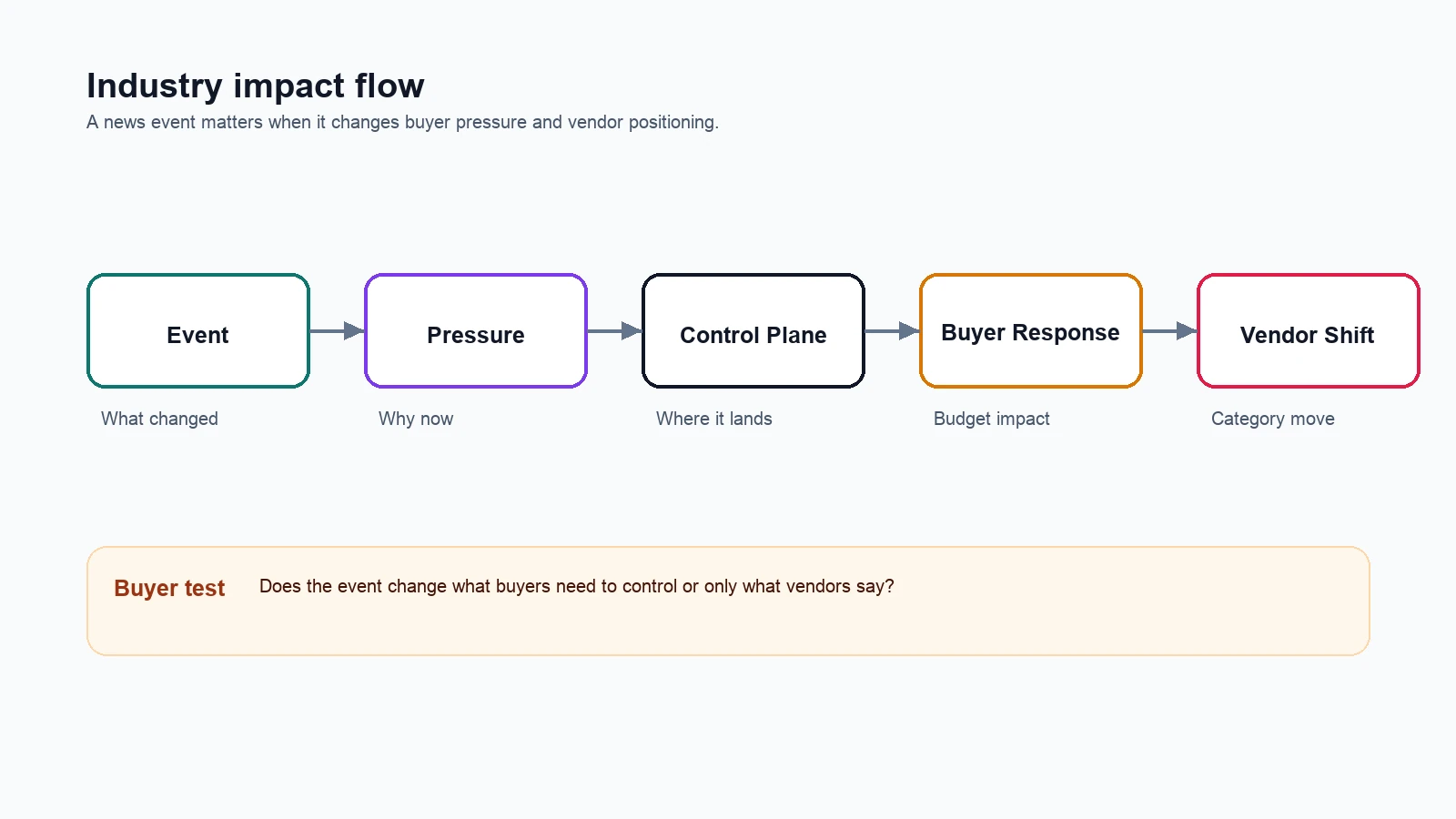
The FY27 budget proposal landed first, on April 6, with a $707 million cut to CISA on top of cuts already absorbed in the FY26 cycle. NIST took a $993 million reduction in the same proposal — the agency that publishes the cybersecurity framework most U.S. enterprise security programs are built on. The budget signal alone would have been digestible. It was the next two weeks that turned a budget into a structural change.
On April 22, Sean Plankey, the nominated CISA director, withdrew. Thirteen months in Senate limbo without a confirmation vote is itself a signal — the political appetite to staff CISA at the top has thinned. A week later, on April 29, Federal News Network's reporting on staff attrition inside the stakeholder engagement division landed. The number — more than half — is striking, but the framing is sharper: most partnership work is at a standstill. That is not a budget anecdote. That is a description of the layer of CISA that the rest of the cybersecurity industry actually interacted with.
May 5 closed the loop, and not in the direction of stabilization.
What the federal backstop actually was
Most people in cybersecurity have never had to think hard about what CISA, the JCDC, MS-ISAC, and the various sector ISACs actually do. That is part of the point. The federal layer worked invisibly. It published indicators of compromise. It convened operator meetings nobody had to budget for. It provided a coordinating function during incidents — the call you made when ransomware was spreading through a hospital chain or when a state-sponsored campaign hit your supply chain.
Critical Infrastructure Partnership Advisory Council coordinated public-private response. Joint Cyber Defense Collaborative let private security vendors share signal with government and with each other. MS-ISAC supported state and local governments. Sector ISACs in financial services, healthcare, water, oil and gas, and electric power did the same in their lanes. None of it was free in the strict sense — taxpayers paid — but it was free at the point of use for the cybersecurity industry. That made it invisible to most procurement teams and almost all category strategy.
CIPAC was eliminated. JCDC has been running on rolling two-week contractor extensions. MS-ISAC moved to paid membership in late 2025 after federal funding ended. The sector ISACs have been quietly tightening their paid tiers. April compressed the trajectory of the entire federal coordination layer into a single news cycle.
May 5 was the giveaway
Of the four April-May events, the May 5 guidance is the most important.
The acting director of CISA told critical-infrastructure operators to assume they will need to disconnect from third-party networks and operate manually if they come under attack. That is not a recommendation. That is an official concession. The agency that spent the past decade telling operators *do not run a critical-infrastructure response alone* is now telling them to plan for exactly that.
Read in isolation, this looks like prudent contingency guidance. Read alongside the budget and the staffing collapse, it reads as policy. When the agency itself signals isolation as the planning baseline, the coordination layer it provided is, by its own admission, no longer reliable.
The industry's response will not be to lobby for restoration. It will be to buy the substitute.
Coordination is no longer a public good. It is a paid product.
The cybersecurity industry has built large categories around problems CISA used to share the load on.
Commercial threat intelligence vendors like Recorded Future, Mandiant (now part of Google Threat Intelligence), CrowdStrike Falcon Intelligence, Microsoft Threat Intelligence, and Flashpoint sell what is, in part, indicators-of-compromise distribution and adversary tracking that overlapped with CISA's free advisories. Incident response retainers from Mandiant, Unit 42, CrowdStrike Services, Kroll, and Arete sell the surge capacity that used to come, in part, from JCDC mobilization. Sector ISACs that historically operated as free or low-cost member services — FS-ISAC for financial services, H-ISAC for healthcare, E-ISAC for electric, WaterISAC for water — are increasingly running paid membership tiers as their federal funding has thinned.
The shift is not a doubling. It is a re-pricing. What used to be priced as a marginal addition to the federal backstop now has to be priced as the backstop itself. That changes the mental model on the buyer side. It changes the TAM on the vendor side.
Public security platforms gain TAM
For public cybersecurity companies, the privatization of the coordination layer is a tailwind that will not show up cleanly in any single quarter's earnings. It will compound across renewals.
CrowdStrike sells Falcon Intelligence and Services into a market where customers now have to assume the federal coordination layer is unreliable. Palo Alto Networks sells Unit 42 into the same market. Microsoft sells Threat Intelligence and Defender Experts into it. Cloudflare sells one-stop network protection in part as a hedge against coordinated attacks customers can no longer count on the government to convene a response for. SentinelOne sells Vigilance MDR into mid-market customers who never had a real federal coordination relationship to begin with and now need a commercial substitute.
The earnings effect of this is gradual and hard to attribute to any single event. The M&A logic is sharper. Platform consolidators (Cisco post-Splunk, Palo Alto's serial acquisition pattern, the AI-agent platform M&A wave we've covered separately) accelerate because enterprises want fewer vendors to coordinate when no one in Washington is doing the coordinating for them.
What changes for cybersecurity buyers
For procurement teams and CISOs, the privatization of the federal backstop has three practical implications.
The first is line-item budget. Threat intelligence subscriptions, IR retainers, and sector ISAC paid memberships all need to move from optional to baseline. CISOs who built their 2026 budgets assuming a CISA layer of coordination need to rebuild those assumptions for the 2027 cycle. Expect security budgets to grow at the high end of historical ranges in regulated sectors specifically because the federal externality is being internalized.
The second is concentration risk. If you depend on commercial threat intelligence, you need to know which two or three vendors you actually depend on, what their indicator coverage looks like for adversaries you actually face, and what happens to your incident response if that vendor itself has a bad week. The federal backstop, for all its flaws, was a redundancy layer. Its absence means the commercial layer is your only layer.
The third is sector-specific. If you are in critical infrastructure, you should be reading the OT vendor risk question alongside this one. NERC CIP and TSA pipeline directives still exist. Their enforcement assumes a coordinating CISA. That assumption is now load-bearing on a coordination layer that has visibly hollowed out.
What changes for cybersecurity founders
For founders building or raising in 2026, three implications follow from April.
Paid replacements for federal-tier capabilities are the next defensible category bet. A *commercial CISA-lite* for sector-specific coordination, paid threat-intel-as-a-service for the mid-market that never had real federal access to begin with, and managed national-defense-grade services for the Fortune 500 are all underexplored. The competitive moat is a combination of analyst headcount, data partnerships, and customer trust — not novel software.
Sector ISAC-as-a-service is real now. The shift from free or low-cost membership to paid-tier models at MS-ISAC and the sector ISACs has created an opening for SaaS-native challengers. Founders who can productize sector intelligence at a price point below what the public ISACs charge but with cleaner integrations will find demand.
OT and ICS specialists have a faster TAM expansion than IT-focused vendors. The federal backstop in OT was thinner to begin with — but the CISA OT advisory function specifically had been propping up smaller utilities and water authorities. Its absence widens the addressable market for Dragos, Claroty, Nozomi, and Armis materially. Expect the next twelve months to surface at least one major raise or acquisition in this group anchored on this thesis.
What to watch next
Three signals over the next two quarters will tell us how durable the privatization is.
The first is the FY27 budget actually passing or being amended. Congress may restore some of the proposed cuts. The shape of the final appropriation, more than the proposal, sets the structural baseline. Watch the appropriations committee markup language — it will say more about the durable trajectory than the budget release did.
The second is the next CISA director, if one is named. A confirmed director with operational authority changes the calculus. A continued vacuum at the top accelerates it. The longer the agency runs under acting leadership, the harder the privatization is to reverse.
The third is M&A pricing on the threat-intel and sector-ISAC categories. If a public security platform announces an acquisition of Recorded Future, Flashpoint, or a similar pure-play in the next twelve months, the privatization thesis wins on the buy side. If sector ISACs raise outside capital at premium valuations, it wins on the equity side. Either outcome, or both, would be the M&A read confirming what the budget already implied.
The federal cyber backstop existed for a decade because nobody in the industry had to think about who paid for the coordination layer. April was the month everyone in the industry has to start.
Frequently asked questions
- What changed in April 2026 with CISA?
- Three events compressed into roughly two weeks: the FY27 budget proposed cutting $707 million from CISA and $993 million from NIST, the director nominee Sean Plankey withdrew after thirteen months of Senate inaction, and Federal News Network reported the agency's stakeholder engagement division had lost more than half its staff with most partnership work *at a standstill*. The May 5 guidance from the acting director — telling critical-infrastructure operators to plan for isolation — was the agency's own concession that the coordination layer can no longer be relied on.
- Why does the privatization of the federal cyber backstop matter for cybersecurity vendors?
- Because most cybersecurity categories grew up assuming a federal backstop existed. Threat intelligence vendors built around CISA advisories. Sector ISACs operated as low-cost member services on top of federal funding. Incident response retainers were marginal additions to the federal coordination layer. When that layer privatizes, the commercial substitutes go from *nice to have* to baseline. The TAM expansion is gradual on any single quarter's earnings but compounds across renewals — particularly for public security platforms with threat-intel and IR product lines.
- Which public cybersecurity stocks benefit from CISA's collapse?
- Most directly, the platforms with substantive threat-intelligence and IR product lines: CrowdStrike (Falcon Intelligence plus Services), Palo Alto Networks (Unit 42), Microsoft (Threat Intelligence plus Defender Experts), Cloudflare (network protection as a coordination hedge), and SentinelOne (Vigilance MDR for mid-market). The earnings effect is gradual. The M&A read is sharper: identity and platform consolidation accelerates because enterprises want fewer vendors to coordinate when no one in Washington is doing the coordinating for them.
- What should CISOs and procurement teams do differently in their 2027 budget cycles?
- Three things. First, move threat intelligence subscriptions, incident response retainers, and sector ISAC paid memberships from optional line items to baseline. Second, audit concentration risk in commercial threat intelligence — if a single vendor is your only adversary-tracking layer, that is a single point of failure that the federal backstop used to cover. Third, particularly in critical infrastructure, treat NERC CIP and TSA pipeline directive enforcement as load-bearing on a coordination layer that has visibly hollowed out — and budget the commercial substitutes accordingly.
Related on CyberBiz
- Cybersecurity market map — Where threat intelligence, IR, and OT specialists sit within the broader cybersecurity vendor landscape.
- Public cybersecurity companies — The public security platforms positioned for TAM expansion as the federal coordination layer privatizes.
- CrowdStrike stock profile — Falcon Intelligence and Services revenue lines map directly to capabilities CISA used to share the load on.
- Palo Alto Networks stock profile — Unit 42 IR retainers and platform consolidation thesis.
- Itron breach analysis — Companion piece on OT vendor risk — NERC CIP enforcement is now load-bearing on a CISA layer that has hollowed out.
- Newsroom — Live cybersecurity market feed: regulatory shifts, M&A, funding rounds.
Sources
- CISA cyber partnerships face standstill amid cuts — Federal News Network
- Sean Plankey withdraws CISA director nomination — CyberScoop
- FY27 budget proposes cuts to CISA, NIST, IRS — Government Executive
- CISA tells critical organizations to prepare for cyber outages — Federal News Network
- Cyber experts: DHS funding cuts have stalled security — PYMNTS
Topics
Threat Intelligence · Governance, Risk, and Compliance · Incident Detection and Response · Industrial Control Systems
Written by
Tal Eliyahu
Editor at CyberBiz, covering cybersecurity vendors, M&A, and platform shifts.