CISA Makes Risk-Based Vulnerability Management Real
CISA BOD 26-04 turns patching into exploitability triage. Exposure, KEV status, automation, and impact now define the remediation queue.
By Tal Eliyahu · · 8 min read
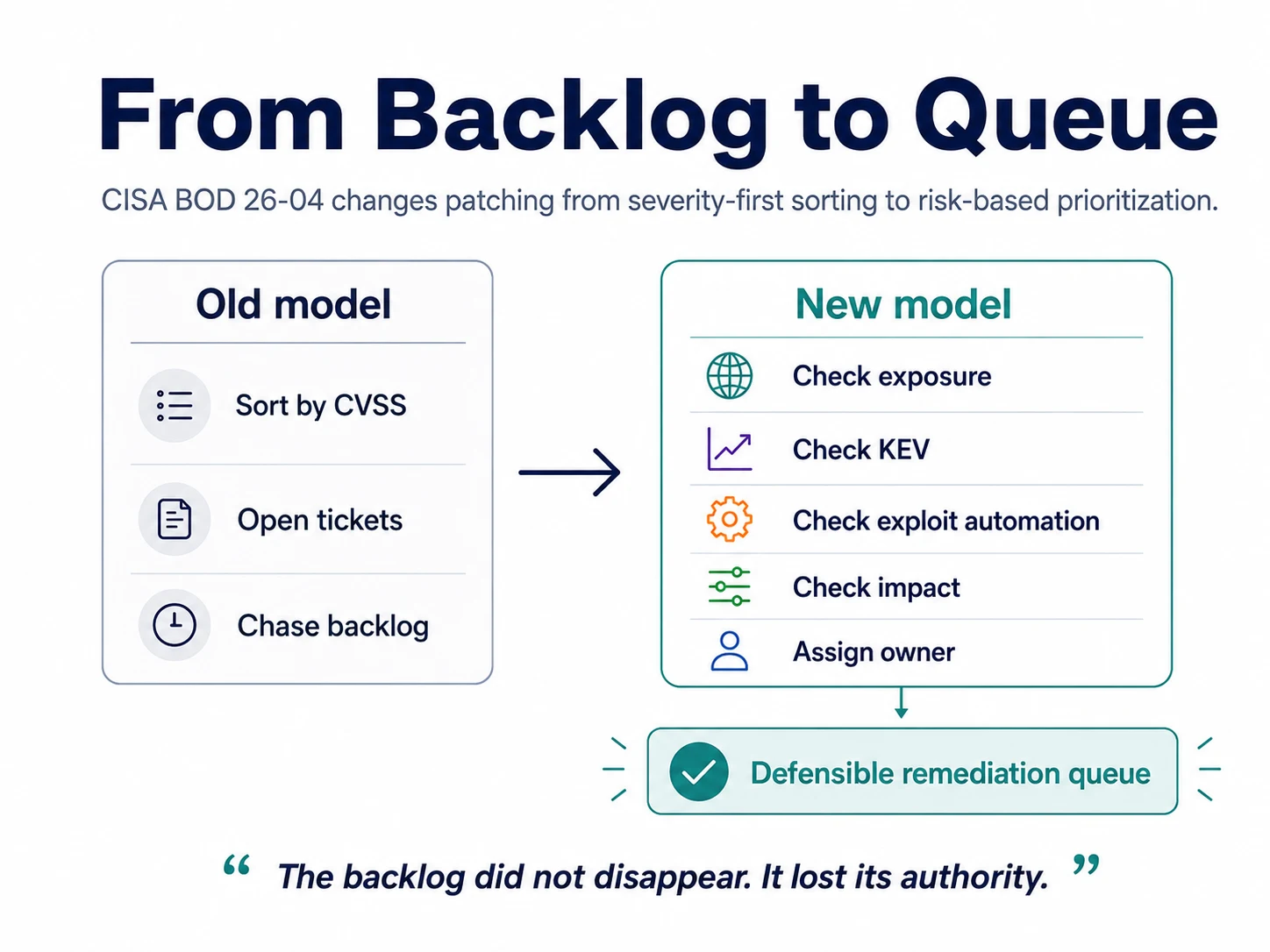
Severity lost its monopoly.
For two decades, vulnerability management has been sold as a scoring problem. Find the CVEs, sort by severity, open tickets, chase owners, report the backlog, repeat. CISA just made that model look old.
The agency's new directive is easy to dismiss as federal housekeeping. It is not. It is the clearest official move yet toward a version of vulnerability management that is not about finding more issues. It is about deciding which issues can become incidents first.
That is the queue now.
CISA just replaced the backlog with a queue
CISA released Binding Operational Directive 26-04 on June 10, 2026. The directive applies to Federal Civilian Executive Branch agencies, meaning it is mandatory for the federal civilian systems CISA governs. It does not directly bind private companies, contractors unless their governing contracts require it, national security systems, or certain systems operated by the Department of War or the Intelligence Community.
The substance is still market-moving.
Under BOD 26-04, agencies have to prioritize remediation using four factors: whether the affected asset is publicly exposed, whether the CVE is in CISA's Known Exploited Vulnerabilities catalog, whether exploitation can be automated, and whether exploitation gives the attacker partial or total control of the vulnerable asset. The top tier requires remediation or mitigation within three calendar days, and entries marked for forensic triage require agencies to assess whether compromise already happened.
That is not a normal patching SLA. It is a policy version of attack-path logic.
Many people will read the directive as CISA telling agencies to patch faster. That read is too small. CISA is telling agencies to patch differently. Lower-priority vulnerabilities can move to longer timelines, and in some cases can wait until the next system upgrade. The forcing function is not universal acceleration. It is sharper selection.
The backlog did not disappear. It lost its authority.
The four inputs are a product spec
The most important part of BOD 26-04 is not the three-day deadline. It is the data model behind the deadline.
Public exposure means the vulnerable asset is reachable from the internet or otherwise visible in a way that makes exploitation more plausible. KEV status means exploitation is no longer theoretical. Exploit automation asks whether an attacker can run the chain reliably at scale. Technical impact asks how much control the attacker gets if the chain works.
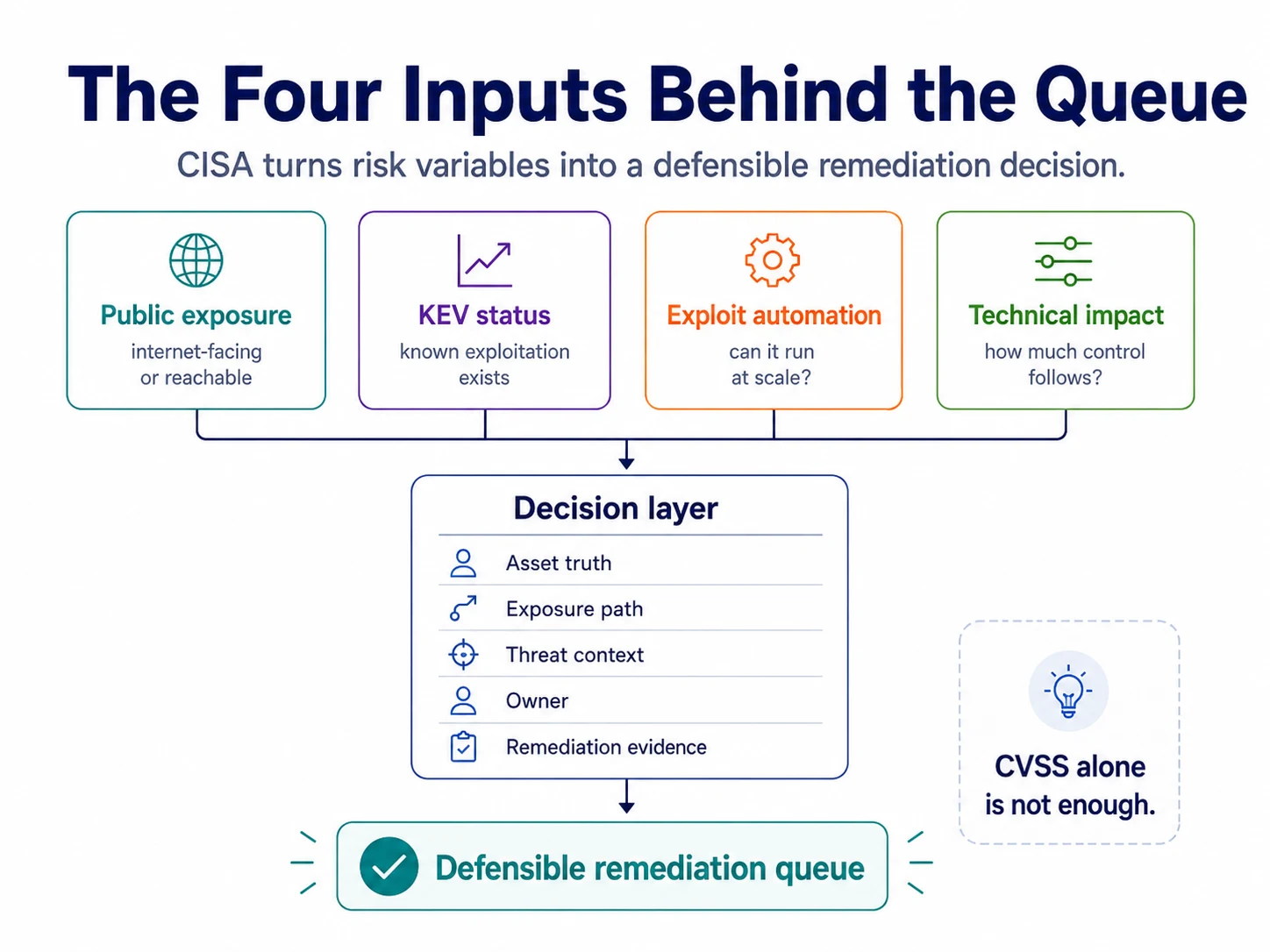
Put those together and the buyer requirement is obvious. A vulnerability platform has to know the asset, the exposure path, the exploit state, the attacker outcome, and the remediation owner. CVSS alone cannot carry that load.
CISA's implementation guidance makes the point plainly by treating vulnerability metadata, environmental context, and threat information as separate inputs. CISA also points agencies toward its Vulnrichment work for CVE-level metadata and toward exposure-discovery sources such as CDM, Cyber Hygiene, scanners, cloud control planes, EDR, NAC, and other inventory systems.
That is a product architecture.
A tool that only says "critical severity" is not enough. A tool that says "critical severity on an internal lab box with no public exposure and no known exploitation" is useful, but not decisive. A tool that says "public-facing system, KEV-listed CVE, automatable exploit, total control after exploitation, owner identified, compensating control absent" is operating in the new model.
This is where CTEM, exposure management, attack-surface management, vulnerability management, CAASM, and remediation orchestration start collapsing into one buying conversation. The categories can keep their names. The buyer will increasingly ask for one answer: what gets fixed first, and why?
AI made the old patching math fail
CISA did not release this directive in a vacuum.
In its Patch Smarter, Not Harder post, CISA ties the directive to the speed of vulnerability discovery and exploitation. The agency points to artificial intelligence helping both researchers and adversaries find flaws faster, while defenders are already behind. CISA also cites Verizon's 2026 DBIR figures: only 26% of KEV-listed vulnerabilities were fully remediated by organizations in 2025, down from 38% the prior year, and median full-resolution time rose to 43 days.
That is the whole problem in one paragraph. More findings. Faster weaponization. Slower remediation.
The old operating model assumes the bottleneck is visibility. If security teams could just find every vulnerability, the organization would get safer. That assumption is now backwards. Most mature teams can find more risk than they can fix. The bottleneck is prioritization, ownership, change control, and proof that the chosen remediation reduced real exposure.
CISA's own early analysis makes the strategy legible. In one large civilian agency, the agency said only about 1% of vulnerability instances fell into the three-day category, while more than 60% could be deferred until the next system upgrade. That is the important number. Risk-based vulnerability management is not a slogan for doing everything faster. It is a mechanism for doing a small number of things much faster and a large number of things later on purpose.
That is why the directive will travel beyond federal agencies.
It also explains the tension with the earlier CyberBiz read on CISA's shrinking backstop. A thinner federal cyber layer does not stop setting standards. It sets standards that private vendors, insurers, auditors, and customers have to operationalize.
The winners connect exposure to action
The vendor market has been preparing for this moment without always naming it.
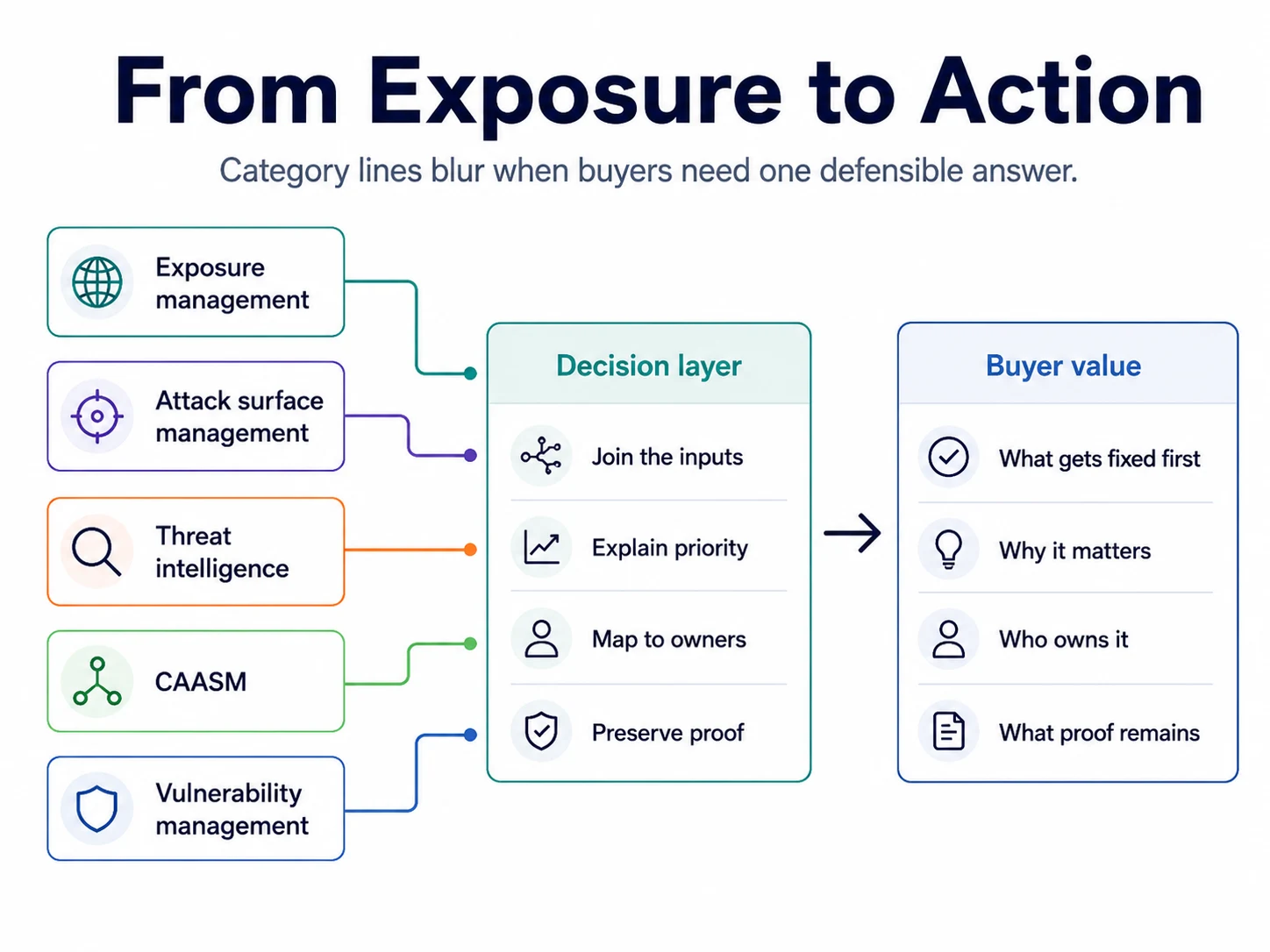
Exposure-management companies have argued that asset context beats raw severity. Attack-surface management vendors have argued that internet exposure changes priority. Threat-intelligence vendors have argued that exploitation evidence matters more than theoretical exploitability. Vulnerability-management vendors have argued that remediation workflows are the durable control. CAASM vendors have argued that asset truth is the missing layer.
CISA just put all of those claims into one federal operating model.
The winners are the platforms that can join the inputs without making the analyst do the stitching. They need to ingest CVE metadata, KEV status, exploitability, public exposure, business context, cloud tags, ownership, compensating controls, change windows, and remediation evidence. They also need to explain the decision in language a CISO, system owner, and auditor can defend.
That last part matters. BOD 26-04 does not only create speed pressure. It creates explainability pressure. If a team patches one vulnerability in three days and defers another to the next system upgrade, the record has to show why. The control is not only the patch. The control is the defensible queue.
This is the procurement shift. Buyers should stop asking whether a product has risk-based prioritization as a feature. Everyone has that slide. The real question is whether the product can produce a patch queue that survives a board conversation, an incident review, and an audit.
That is a higher bar.
Buyers should change the RFP now
For buyers, the practical move is simple: rewrite the vulnerability-management RFP around the four CISA variables.
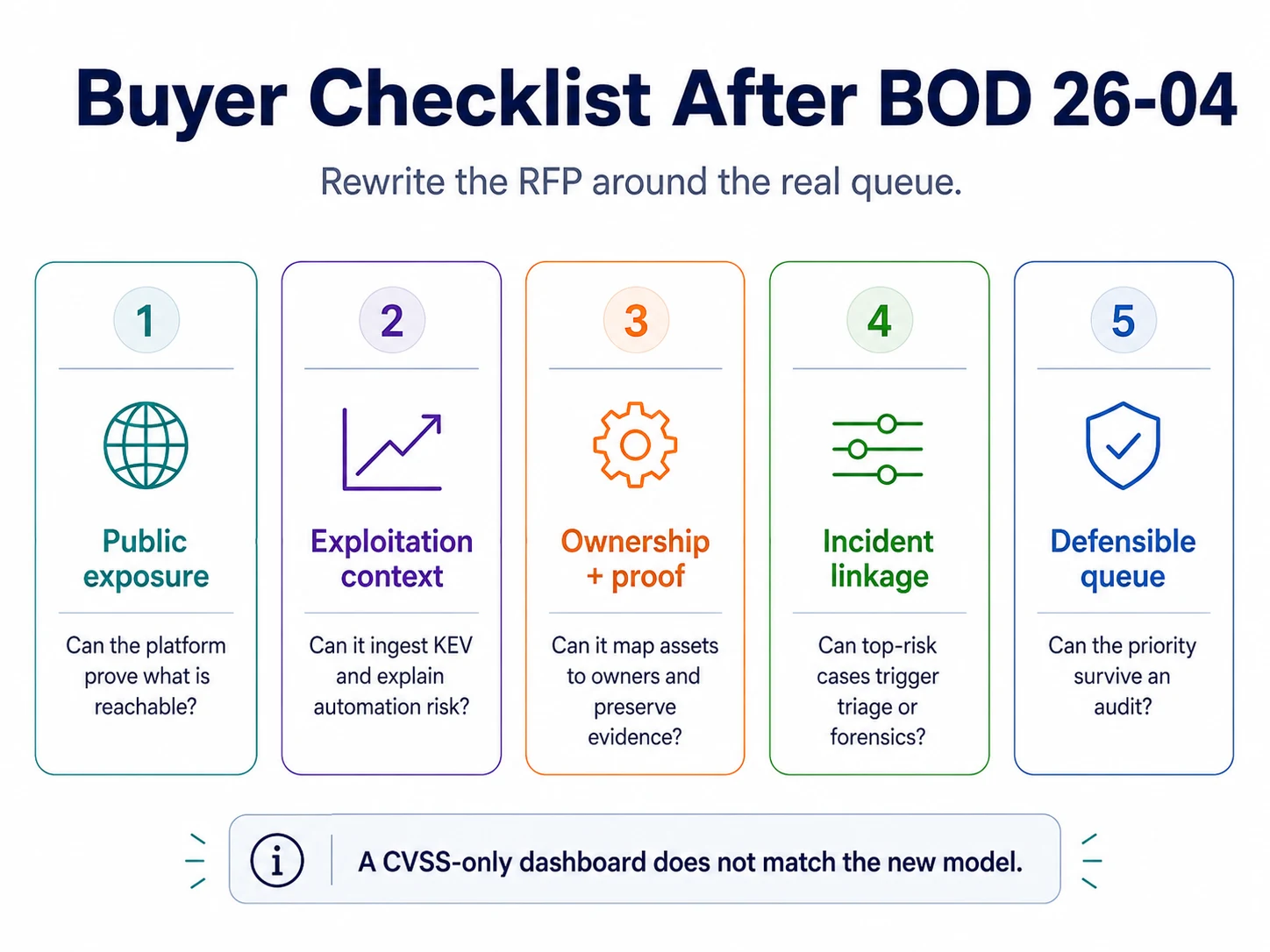
First, require proof of public exposure. Do not accept a generic asset count. The platform should identify whether the vulnerable asset is internet-exposed, reachable through a public service, visible through cloud configuration, or protected by meaningful controls. If the answer is unknown, the workflow should treat unknown exposure as a risk decision, not as missing data.
Second, require exploitation context. KEV status is the obvious baseline, but the platform should also explain whether exploit steps can be automated and what control an attacker gains after exploitation. That changes the conversation from "is this CVSS 9.8" to "can this become initial access at scale."
Third, require ownership and remediation proof. A queue without an owner is just another dashboard. The tool has to map the asset to a team, create or update the remediation workflow, track exceptions, and preserve evidence that the vulnerability was eliminated, mitigated, or consciously deferred.
Fourth, require incident-response linkage for the highest-risk cases. If a vulnerability meets the top-risk threshold, patching is not enough. The organization also needs a lightweight triage path to ask whether exploitation already happened. That is where vulnerability management touches detection, forensics, and incident response.
This is not only a federal concern. Companies that sell to government, run critical infrastructure, support regulated environments, or carry board-level cyber-risk reporting will feel the standard first. Everyone else will feel it when insurers, auditors, and customers start asking why their patch queue does not look like the CISA model.
The buying motion moves from "scan and patch" to "prioritize, prove, and defend."
The queue is the control
There is a bear case.
Three-day patching can be brutal in real environments. Change windows exist for a reason. Legacy systems do not always have clean patches. Cloud assets can be owned by teams that no longer exist. Third-party products can embed vulnerable components without giving the customer a direct remediation path. CISA's implementation guidance spends real space on third-party vendors, cloud service providers, high-value assets, and the need for explicit risk decisions because the hard cases are not theoretical.
That complexity does not weaken the directive. It explains why the directive matters.
The industry has spent years pretending vulnerability management is a throughput problem. More scans. More findings. More tickets. More dashboards. But the hard part was never producing more work. The hard part was choosing which work reduces the most risk under operational constraints.
CISA just gave that choice a public framework.
For founders, the pressure is category-level. If your product cannot connect exposure, exploitability, technical impact, ownership, and remediation evidence, you are selling into an older market. For investors, the pressure is consolidation. The standalone winners will be the companies that own the decision layer, not the ones that own one more scan feed. For buyers, the budget case is clearer. The tools that help you defend the queue deserve priority over the tools that only expand the backlog.
The backlog is not going away. It never does.
But the queue is now the control.
Frequently asked questions
- What is risk-based vulnerability management?
- Risk-based vulnerability management prioritizes remediation based on the chance that a vulnerability can become a real incident, not only on severity score. In the CISA model, that means combining asset exposure, known exploitation, exploit automation, and attacker impact. The output is a defensible remediation queue, not a larger backlog.
- What is CISA BOD 26-04?
- BOD 26-04 is CISA's June 10, 2026 Binding Operational Directive on prioritizing security updates based on risk. It requires Federal Civilian Executive Branch agencies to update vulnerability management policies and use CISA's risk variables to determine remediation timelines. The highest-risk cases can require remediation within three days plus forensic triage.
- Does CISA BOD 26-04 apply to private companies?
- The directive is mandatory for covered federal civilian agencies, not private companies. The directive still matters because CISA strongly encourages partners to adopt similar vulnerability management practices. Regulated companies, government suppliers, and critical-infrastructure operators are likely to feel the standard first.
- What should buyers ask vulnerability management vendors after BOD 26-04?
- Buyers should ask whether the platform can prove public exposure, ingest KEV and exploitability context, estimate technical impact, map assets to owners, and preserve remediation evidence. A dashboard that only ranks by CVSS does not match the new model. The buyer needs a queue that can survive an incident review and an audit.
- Which cybersecurity categories benefit from risk-based vulnerability management?
- Exposure management, CTEM, attack-surface management, CAASM, threat intelligence, vulnerability management, and remediation orchestration all benefit if they can connect their inputs into one decision layer. The categories most at risk are tools that produce more findings without explaining what should be fixed first and why.
Related on CyberBiz
- Cybersecurity market map — Where vulnerability management, exposure management, and adjacent cybersecurity categories sit in the broader market.
- Newsroom — Live cybersecurity market feed covering policy, products, M&A, funding, and breach events.
- Federal cyber backstop privatizes — Companion analysis on how CISA capacity and federal cyber policy are reshaping private-sector security expectations.
- Agentic security category map — How AI and agentic security categories are changing buyer expectations for automation and governance.
Sources
- BOD 26-04: Prioritizing Security Updates Based on Risk — CISA
- BOD 26-04 Implementation Guidance — CISA
- Patch Smarter, Not Harder — CISA
- CISA Issues New Directive Improving How Federal Agencies Prioritize Vulnerabilities — CISA
- 2026 Data Breach Investigations Report — Verizon
- CISA directive orders agencies to prioritize vulnerability patching in a new way — CyberScoop
Topics
Vulnerability Management · Incident Detection and Response · Threat Intelligence · Governance, Risk, and Compliance · Orchestration and Automation
Written by
Tal Eliyahu
Editor at CyberBiz, covering cybersecurity vendors, M&A, and platform shifts.