Cloudsmith's $72M Round and the Autonomous-Publisher Bet
Cloudsmith raised $72M from TCV and Insight Partners. The bet: AI's bigger cybersecurity problem is autonomous publishers, not autonomous attackers.
By Tal Eliyahu · · 9 min read
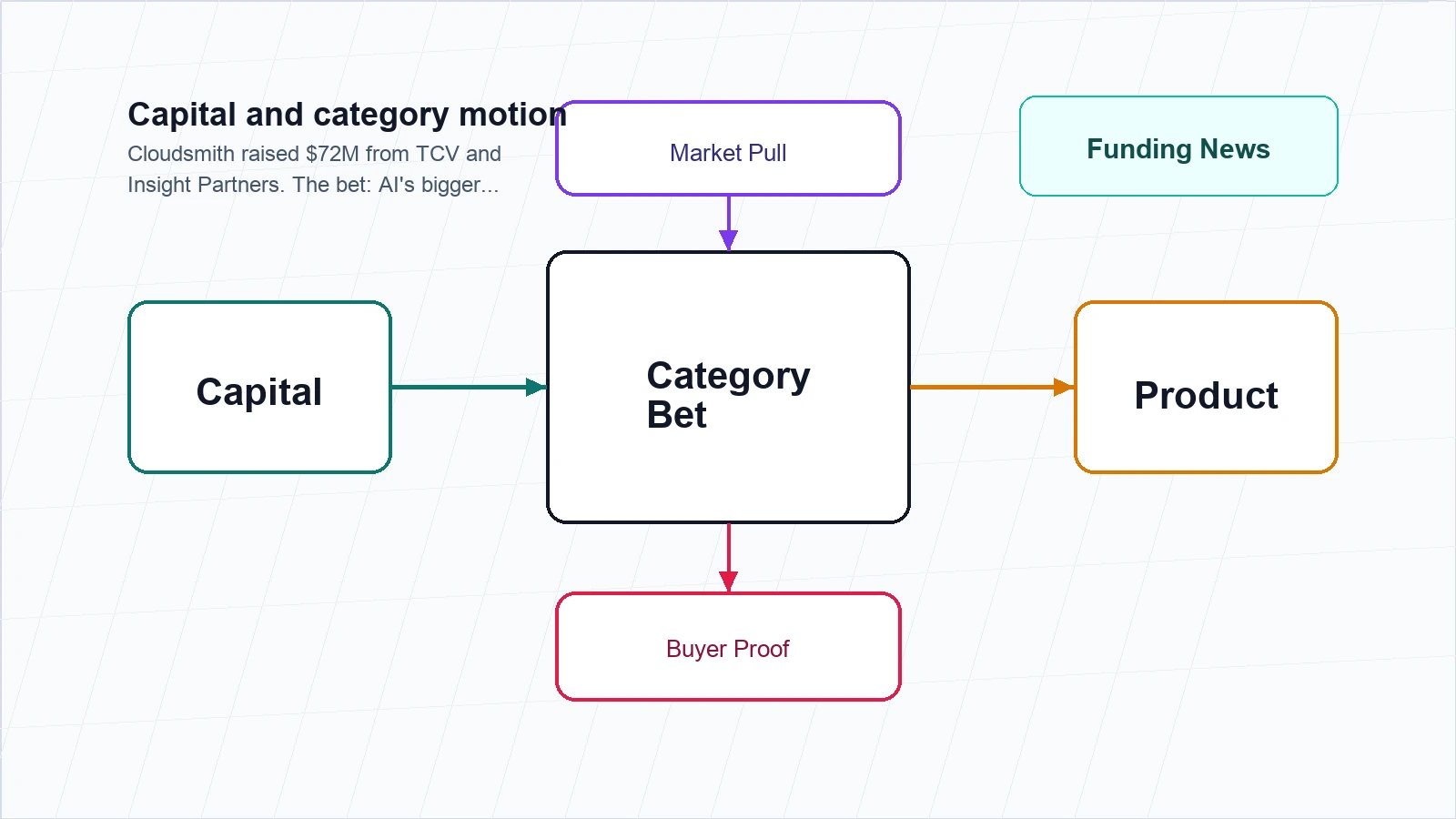
The cybersecurity industry has spent eighteen months building autonomous defenders for autonomous attackers. Cloudsmith's $72 million Series C bets the bigger problem is autonomous publishers.
The Belfast-based artifact management company closed the round on April 23, 2026, led by TCV with participation from Insight Partners. Cloudsmith now sits at roughly $124 million in total funding ten years after founding. The headline number is decent. The thesis is more interesting.
For most of 2026, cybersecurity capital has flowed to agentic defense — XBOW for autonomous offensive testing, 7AI for agentic SOC, Artemis for AI-vs-AI defense, and the Cisco/Astrix and PANW/Portkey M&A wave for the agent-era control plane. Cloudsmith is funding the inverse: the choke point that has to exist when humans stop being the bottleneck on what gets shipped.
What happened
Cloudsmith operates what it calls a universal artifact management platform. Every software package an engineering team pulls in or publishes — from open-source dependencies to private container images to ML models — passes through Cloudsmith's registry. Policy is applied at the gate: vulnerability scans, license checks, access controls, integrity verification. The product replaces legacy package repositories like JFrog Artifactory and Sonatype Nexus at Fortune 500 and Global 2000 customers, per Tech.eu coverage of the round.
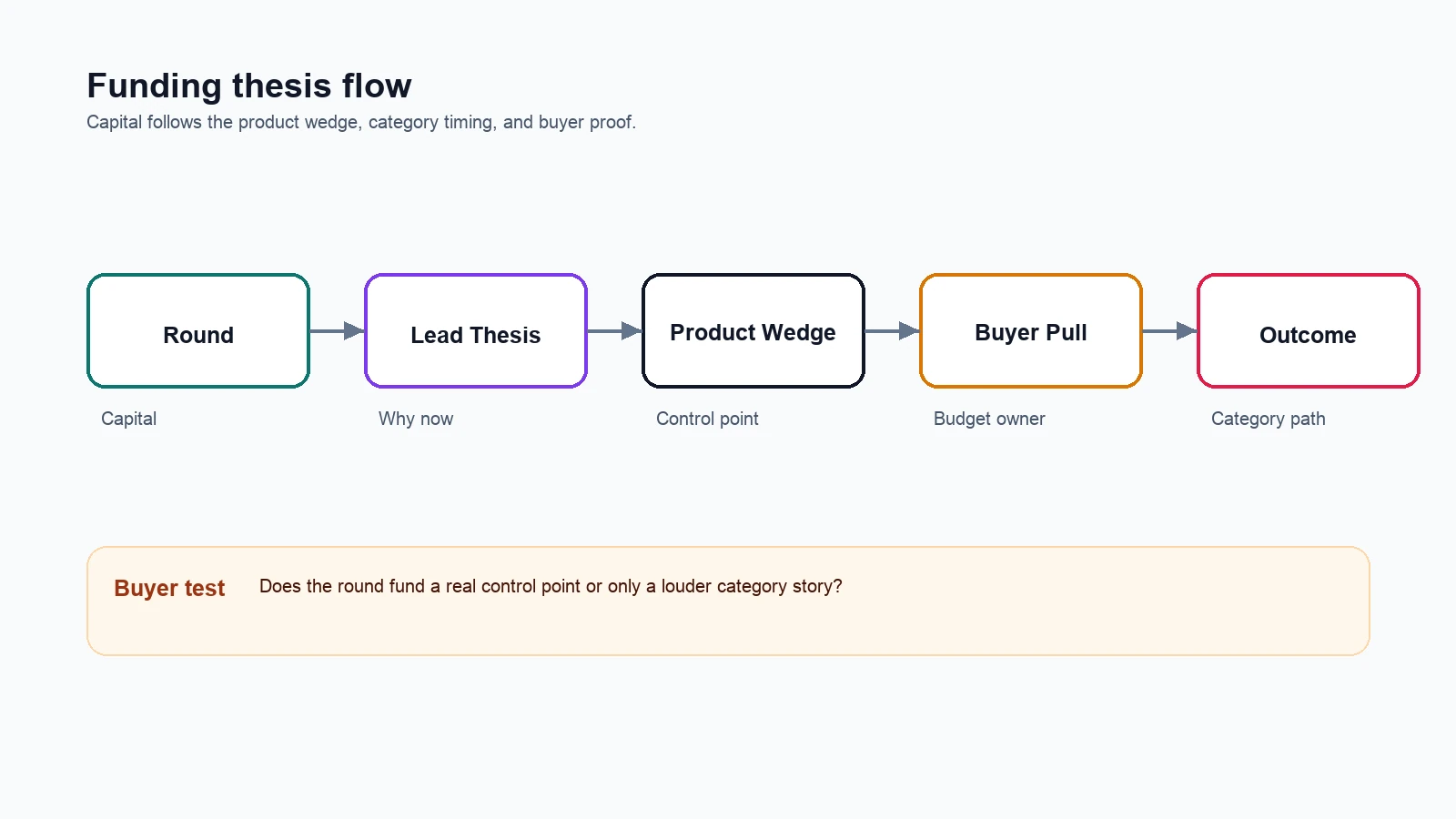
The Series C is led by TCV — the growth investor whose portfolio includes Spotify, Netflix, Airbnb, and other infrastructure-of-the-internet bets. Insight Partners participated. Insight is the same firm that led GitGuardian's $50 million Series C in February 2026 in the adjacent secrets / supply-chain layer, reported in the same SecurityWeek funding rollups.
TCV's signature is the second story this deal tells. We will return to it.
What Cloudsmith called out in its own announcement is what the round is funding: AI agents creating, modifying, and submitting software faster than human reviewers can keep up. The pitch to TCV was that the artifact registry is the only place left where that velocity gets forced to slow down.
The autonomous-publisher problem
For two years, the cybersecurity industry has framed the AI-coding wave as a defender's problem. Autonomous attackers will probe applications faster than humans can patch. Autonomous reconnaissance will discover vulnerabilities at scale. Autonomous social engineering will target enterprises in ways no SOC analyst can triage. The funded answer has been autonomous defenders — agentic SOC, AI-vs-AI defense, autonomous offensive security as continuous coverage.
Cloudsmith's bet is that the bigger problem hides on the other side of the org chart.
The same AI tools that let attackers move faster let engineers ship faster. Copilot, Cursor, Claude Code, and the next generation of coding agents are turning every developer into a software publisher operating at machine speed. A single engineer can now generate a dependency-heavy service, refactor a codebase across hundreds of files, and merge a hundred commits in an afternoon. The bottleneck used to be human review at the pull request. The bottleneck is moving — to wherever the artifact actually exits the engineer's workflow and becomes something a build system, a deployment pipeline, or a customer can pick up.
That somewhere is the registry.
The autonomous-publisher thesis says the choke point of governance has shifted from code review to artifact governance. Whether the human pull-request reviewer caught the problem matters less than whether the registry that holds the resulting package, container, and model enforces policy. If the registry layer is permissive, AI-coding velocity carries shadow dependencies, untracked secrets, unscanned containers, and unsigned models into production at the speed of a competent engineer typing.
That is a different threat model than the one most of 2026's cybersecurity capital is funding. Cloudsmith is the cleanest expression of it so far.
TCV's signature is the second story
The cap-table angle on Cloudsmith's round deserves separate attention.
TCV is not a cybersecurity specialist. It is a generalist growth fund best known for Spotify, Netflix, Airbnb, and Splunk's pre-IPO round — bets on infrastructure-of-the-internet companies that became the rails for entire categories. TCV leading a cybersecurity Series C in 2026, instead of a Cyberstarts, a Greylock, or a Sequoia, is unusual.
It is also informative.
The signal is that supply-chain security is graduating from a niche cybersecurity bet into mainstream software infrastructure investing. When TCV writes a $72 million growth check, the comparable set the firm is benchmarking against includes JFrog, Snyk, HashiCorp, and the broader DevOps tooling cohort. That is a different valuation universe than where pure-play cybersecurity Series C rounds typically get priced.
For Cloudsmith specifically, the implication is access to a generalist-software acquirer base that pure-play cyber funds rarely deliver. JFrog could buy. HashiCorp could buy. GitHub (Microsoft) could buy. ServiceNow could buy — and given its $7.75 billion Armis acquisition, it is now demonstrably willing to write nine-figure cyber-adjacent checks. The acquirer set is wider than it looks.
For the cybersecurity industry, the implication is broader. Generalist growth capital is rotating away from frontier AI bets at $1B+ stealth valuations and toward picks-and-shovels infrastructure with real revenue. That rotation will pull more supply-chain security companies into the funnel — and it will reset the multiples those companies get priced at.
The registry layer as the new choke point
The registry is the place where almost everything an engineering team produces is forced to converge before going anywhere else. Build systems pull from it. Deployment pipelines push to it. CI/CD reads dependency manifests against it. Security scanners hook into it. Compliance auditors trace it.
Historically, registries were boring DevOps plumbing. The interesting cybersecurity work happened upstream — in the IDE, the pull request, the SAST/DAST tools — or downstream, in production, EDR, runtime. The registry was treated as transport.
The autonomous-publisher thesis flips that hierarchy. If the speed of artifact production accelerates faster than human review, the upstream and downstream layers get overwhelmed. Code review queues stretch beyond useful time horizons. Production scanners flag too much to triage. The only layer where governance can actually scale is the registry itself, because the registry is the one place every artifact has to pass through, and policy can be applied there in milliseconds without slowing the developer's loop.
That puts the registry in the same structural position the AI gateway has come to occupy in agent runtime. Both are choke points. Both are inline. Both are where policy gets enforced because it is the only place where policy can be enforced at machine speed.
Cybersecurity vendors that have not yet thought of registries as a security control plane will need to. Adjacent vendors — JFrog, Sonatype, GitHub Advanced Security, Snyk, GitGuardian, Anchore — are about to find their products described as supply-chain governance platforms whether they wanted that branding or not.
What changes for cybersecurity buyers
For procurement teams and platform-engineering leaders, Cloudsmith's round is a forward signal that the artifact registry is moving from infrastructure line item to security control.
Three practical implications.
The first is contractual. Artifact registries that ship without policy enforcement, vulnerability scanning, license tracking, and integrity verification will not survive the next renewal cycle in regulated industries. Procurement teams should treat *registry as a security control* the same way they treat *gateway as a security control* and *identity as a security control* — meaning the buying conversation moves from infrastructure to security, with everything that implies for budgets, evaluation criteria, and approval flows.
The second is architectural. Engineering organizations running AI-coding tools at scale need to know what their registry is actually catching. Shadow dependencies, untracked container layers, unsigned ML models, and embedded secrets all flow through the registry — and a permissive registry passes them through. CISOs evaluating their AI-coding strategy should ask which registry their developers are publishing to, and what policy is actually being applied there. The answer is rarely satisfying on first inspection.
The third is consolidation pressure. The cybersecurity supply-chain category is going to consolidate around the registry layer the same way the agent-runtime category consolidated around identity, gateway, and data access. Buyers who lock themselves into a registry without a forward-looking governance roadmap will repeat the procurement mistakes the cloud-security category has been correcting for two years.
What changes for cybersecurity founders
For founders building or raising in 2026, the autonomous-publisher thesis opens specific category bets and closes others.
Open: registry-adjacent governance. Tools that sit at the artifact gate and apply policy, integrity, scanning, or supply-chain attestation are early. The category has not been platform-bought yet — and per the M&A pillar, the platforms are still finishing their agentic-stack acquisitions before they pivot.
Open: AI-coding-specific governance. Tools that target Copilot, Cursor, Claude Code, and the next generation of agentic IDEs specifically — measuring what AI generates, what it modifies, what it imports, and how that propagates downstream — are still early. The category does not have a recognized leader yet.
Closing: pure-play SAST or pure-play container scanning. The defensible territory is at the registry gate or at the AI-tool layer. The middle is being consolidated.
The cap-table implication is also worth taking seriously. If Cloudsmith's round is the first signal of generalist growth funds entering supply-chain security, founders raising in this category should structure their pitch for two audiences. The cybersecurity-specialist audience expects a defensible technical thesis and a category-leader narrative. The generalist software audience expects ARR scale, gross margins, and a developer-tools comparable. Building the deck for both audiences is uncomfortable. The companies that do it will see broader investor sets and better pricing.
What to watch next
Three signals over the next two quarters will tell us how durable the autonomous-publisher thesis is.
The first is whether other generalist growth funds — Tiger, Coatue, ICONIQ, Stripes — start writing checks into supply-chain security. If TCV is alone in 2026, Cloudsmith is an outlier. If two or three more generalist funds enter the category before year-end, the rotation is real.
The second is whether the platforms acquire into this layer. JFrog has the obvious in-category position to defend. GitHub (Microsoft) has the obvious distribution. Snyk has the obvious customer base. Watch for one of them — or for a public security platform extending its agentic-stack play one layer further left into the developer pipeline — to acquire a registry-governance specialist before Q1 2027.
The third is whether AI-coding governance emerges as its own category with funded entrants. The IDE and pull-request layer is still mostly contested by point-tool startups. The next material round in this space will tell us whether AI-coding governance is a feature of registry-governance products like Cloudsmith, or a stand-alone category with its own platform leader. Both outcomes are informative.
The question every cybersecurity buyer, founder, and investor needs to ask through the rest of 2026 is which side of the autonomous bet they are on. If you believe the bigger problem is autonomous attackers, the agentic-defense category is where the next twelve months play out. If you believe the bigger problem is autonomous publishers, the registry is.
Cloudsmith's $72 million says the second bet is real.
TCV is paying for the registry. The autonomous publishers are already typing.
Frequently asked questions
- What does Cloudsmith do?
- Cloudsmith operates a universal artifact management platform: a single registry that holds every software package, container image, and ML model an enterprise consumes or publishes. The platform applies policy, vulnerability scanning, license enforcement, and access control at the artifact gate — the moment a build pulls a dependency or an engineer pushes a release. Founded in Belfast in 2016, the company replaces legacy package repositories like JFrog Artifactory and Sonatype Nexus at Fortune 500 and Global 2000 customers.
- Why is Cloudsmith's funding round different from the agentic-security wave?
- Most cybersecurity funding in 2026 has gone to agentic defense — autonomous tools that detect, investigate, and remediate at machine speed. Cloudsmith's thesis flips the framing. The bigger problem AI introduces is not autonomous attackers, but autonomous publishers — engineers using AI tools who now ship code, dependencies, and models at a velocity that breaks human review. The artifact registry is the layer where that velocity is forced to slow down for governance. Cloudsmith is betting the registry becomes the choke point.
- What does it signal that TCV led the round instead of a cybersecurity-specialist fund?
- TCV is a generalist growth investor whose portfolio includes Spotify, Netflix, Airbnb, and Splunk's pre-IPO round. TCV leading a cybersecurity Series C — instead of a Cyberstarts, Greylock, or Sequoia — signals that supply-chain security is graduating into mainstream software infrastructure investing. The buyer base reading this round is generalist enterprise software, not specialist cyber. That changes the multiples Cloudsmith and similar companies will get priced at, and it widens the universe of strategic acquirers materially.
- How does this fit with other 2026 cybersecurity supply-chain rounds?
- GitGuardian's $50 million Series C in February 2026, also Insight Partners-led, sits one layer over from Cloudsmith — secrets and non-human identity inside the supply chain. Adjacent rounds at the IDE and pull-request layer are funding AI-generated code governance. Read together, these rounds are the early signal of a category forming around the AI-coding supply chain — registry, secrets, code review — that the platforms have not yet bought into. The category leader has not been declared, and the platforms are likely to define it through acquisition rather than wait for a Wiz-shaped winner to emerge organically.
Related on CyberBiz
- Cybersecurity market map — Where supply-chain security and registry governance sit in the broader cybersecurity vendor landscape.
- Public cybersecurity companies — The platforms that have not yet acquired into the supply-chain layer — but are about to.
- XBOW strategic-round analysis — Companion funding piece on the autonomous-defender thesis. Cloudsmith is the inverse bet.
- Cybersecurity M&A 2026 pillar — Where the platforms have already drawn the map, and where supply-chain security still sits unannexed.
- Newsroom — Live cybersecurity market feed: funding rounds, M&A, and product launches.
Sources
- Cloudsmith Raises $72 Million in Series C Funding — SecurityWeek
- Cloudsmith raises $72M Series C to secure the AI-era software supply chain — Tech.eu
- Cloudsmith Raises $72M Series C Led by TCV with Participation from Insight Partners — Yahoo Finance / Business Wire
Topics
Application Security · Third-Party Risk Management · AI Security, Governance and Assurance · Governance, Risk, and Compliance
Written by
Tal Eliyahu
Editor at CyberBiz, covering cybersecurity vendors, M&A, and platform shifts.