PeopleSoft Attacks Turn ERP Into the Data-Theft Surface
ShinyHunters claims PeopleSoft data theft across 100-plus organizations. Oracle is not the whole story: systems of record are now extortion surfaces.
By Tal Eliyahu · · 8 min read
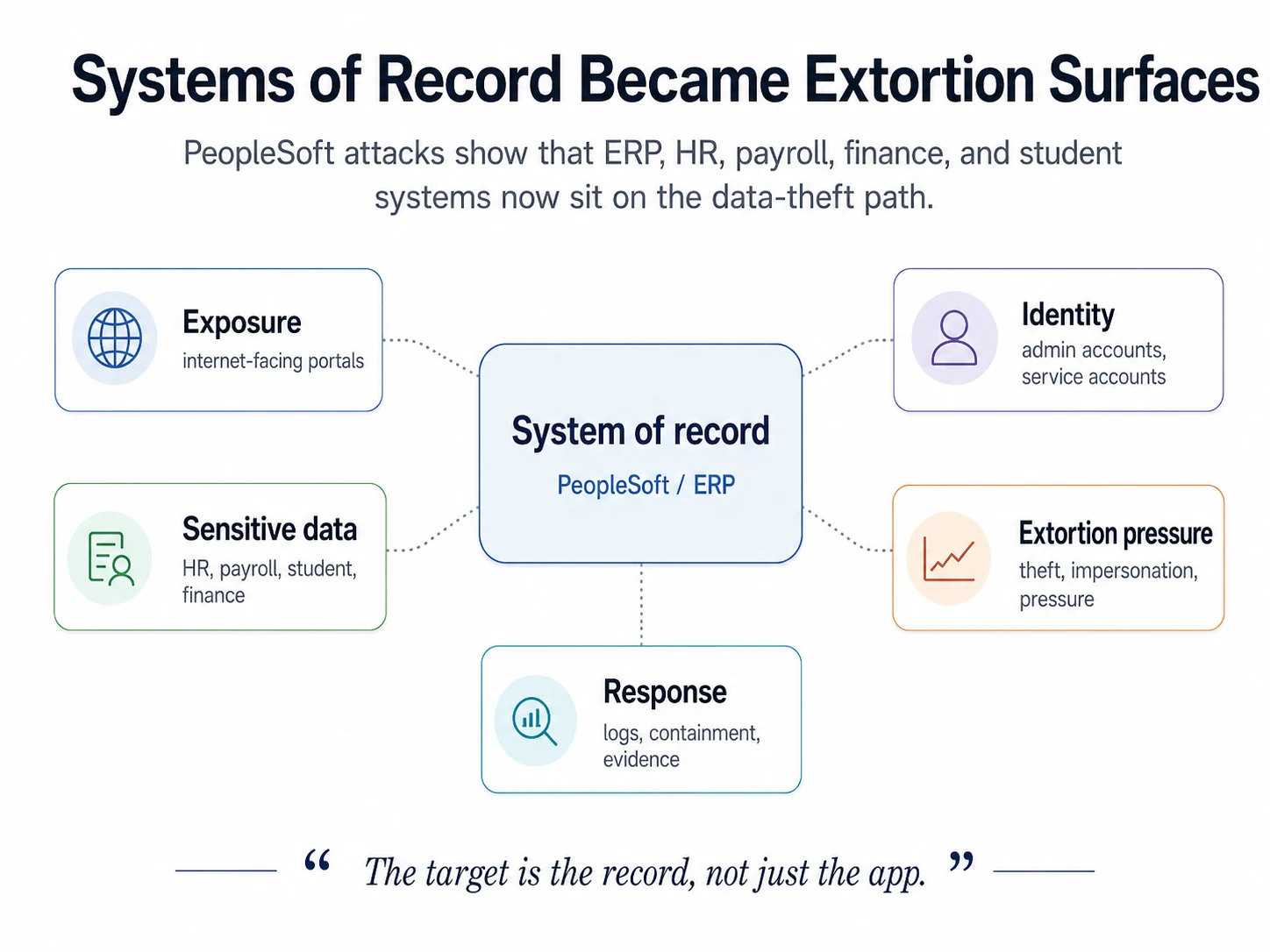
ERP was supposed to be boring.
That was the security assumption behind a lot of enterprise architecture. Customer-facing SaaS gets the attention. Cloud consoles get the new controls. Identity gets the board deck. The system that runs payroll, student records, procurement, finance, HR, grants, fees, and administration sits deeper in the stack. It is critical, but it is treated like back-office plumbing.
The reported Oracle PeopleSoft data-theft campaign is a reminder that boring systems hold the best extortion material.
On June 10, 2026, BleepingComputer reported that Oracle PeopleSoft servers were being targeted in ongoing data-theft attacks attributed by the reporting to ShinyHunters. The group claimed to have stolen data from 300 instances across more than 100 organizations. TechCrunch separately reported that a ShinyHunters member claimed hacks of PeopleSoft servers at more than 100 organizations, many of them universities.
Oracle had not responded to those publications at the time of the cited reports, so the right language is still careful. These are reported claims, not an Oracle-confirmed root-cause narrative. But buyers do not need a finished postmortem to know which controls matter.
Systems of record are now breach surfaces.
The target is the record, not the app
PeopleSoft is not another narrow business application. It is enterprise software used to manage human resources, payroll, finance, procurement, supply chain, student administration, and related operations. In universities and large organizations, that means the platform may sit near exactly the data an extortion actor wants: identity records, employment records, applicant data, student data, financial aid records, fee payments, contact details, and internal administrative context.
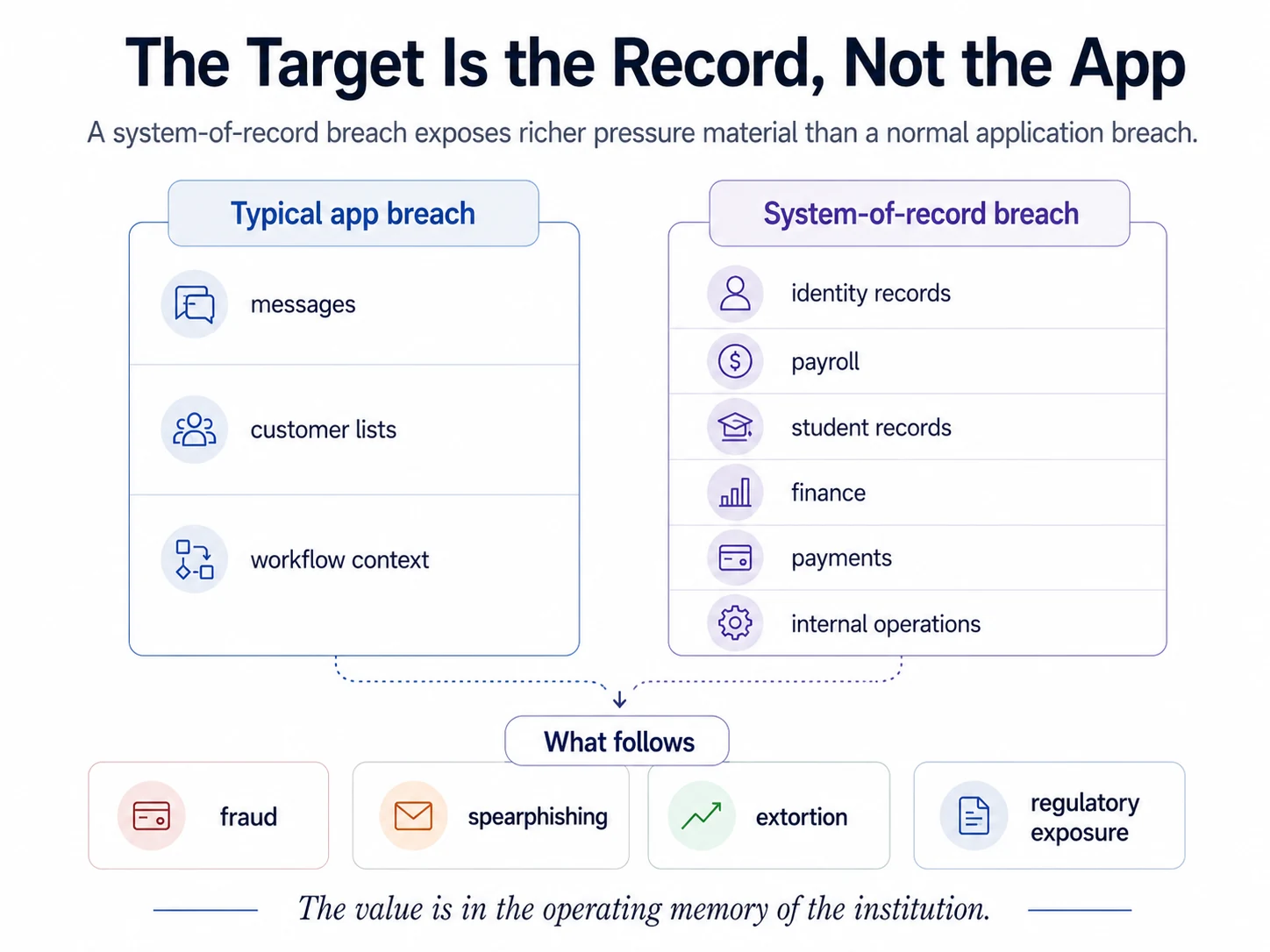
That changes the consequence model.
A breach of a collaboration app can expose messages. A breach of a CRM can expose customers and sales processes. A breach of a system of record can expose the operating memory of the institution. It can tell an attacker who is enrolled, who is employed, who receives aid, who is paid, who handles administration, and which processes are fragile enough to create pressure.
The University of Nottingham example shows the gravity of that data class. Have I Been Pwned lists the June 2026 University of Nottingham breach as involving about 454,600 affected accounts and extensive personal information, including names, addresses, phone numbers, passport numbers, academic records, enrolment information, and fee-payment data. BleepingComputer reported that ShinyHunters named Nottingham in connection with the PeopleSoft campaign, while the university acknowledged a cybersecurity incident.
Do not reduce that to a privacy count.
For a university, the data maps students, alumni, applicants, staff, payments, academic progress, and support needs. For a company, the equivalent system can map employees, payroll, suppliers, procurement, finance, benefits, and internal ownership. It is exactly the kind of context that makes follow-on fraud, spearphishing, harassment, and executive pressure more convincing.
This is why ERP exposure belongs in the breach conversation, not only in the compliance conversation.
ShinyHunters is scaling through shared enterprise systems
The reported PeopleSoft campaign shows the same operating model associated with recent ShinyHunters activity: compromise a widely used business platform, then monetize copied records across many victims.
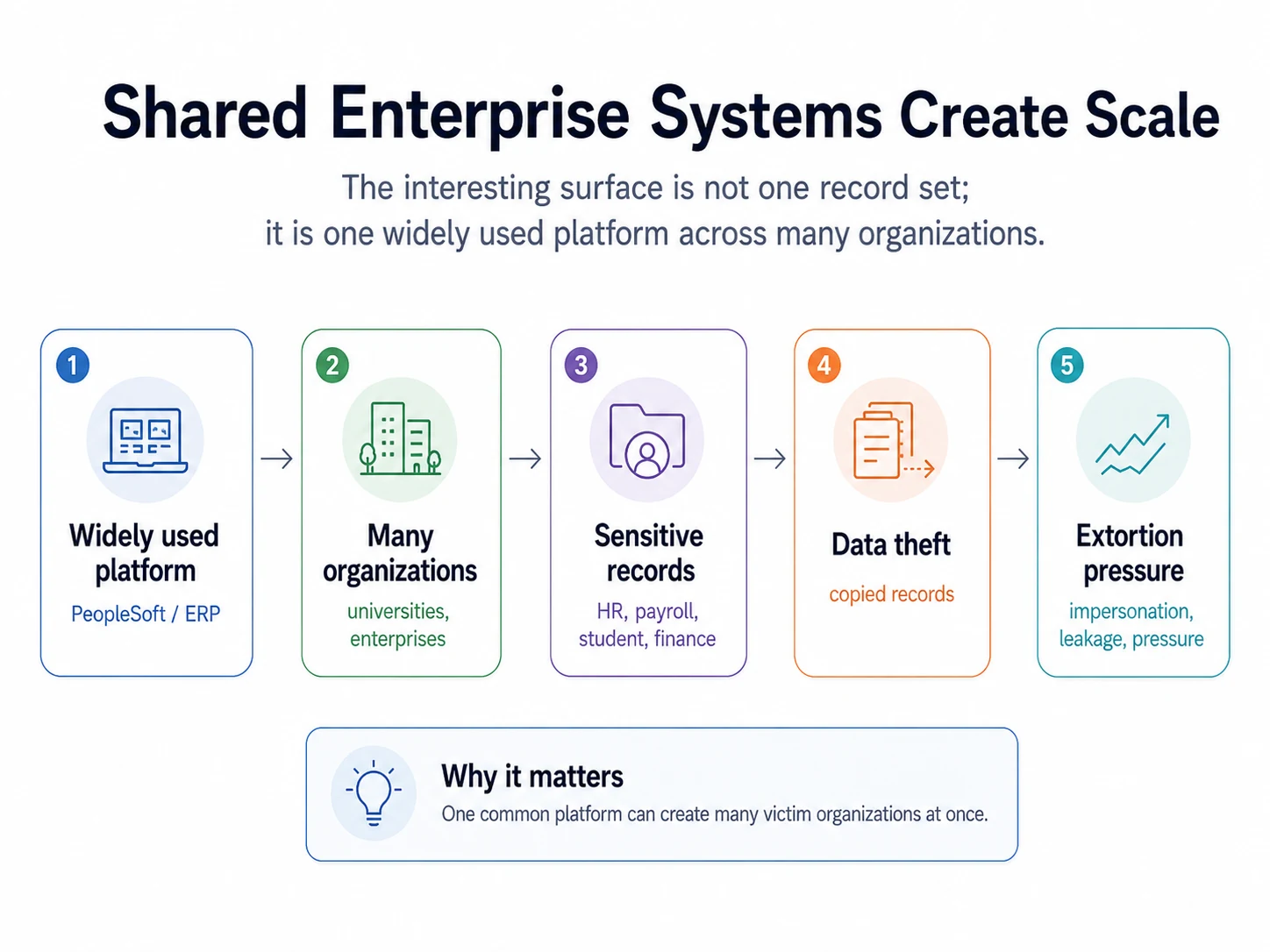
The group is not only looking for one-off targets. It has repeatedly been associated with campaigns where a common enterprise platform, integration layer, or administrative system creates scale. The earlier CyberBiz analysis of ShinyHunters and the Salesforce fabric breach made the same point: the interesting surface was not one database. It was the integrations, admin paths, and third-party access wrapped around Salesforce.
PeopleSoft moves that model from SaaS integrations into ERP records.
The FBI's May 15, 2026 IC3 public service announcement warned that ShinyHunters specializes in large-scale data breaches and extortion, uses pressure tactics around real or exaggerated claims of access, and creates elevated risk for educational institutions with exposed cloud-based management platforms, integrated third-party services, and sensitive data. The same PSA warned that stolen education-platform data can be reused for impersonation and highly contextual spearphishing.
That matters because the risk is not only how the attacker got in. It is what the records let the attacker threaten afterward.
If an actor can say it has payroll records, student records, applicant files, immigration data, health-related administrative data, or fee-payment context, the extortion script writes itself. The victim has to validate scope, notify affected people, preserve evidence, contain systems, manage legal exposure, and communicate under time pressure while the attacker claims to know personal details.
That is not classic ransomware. It is business-process extortion.
The old ERP security model is too narrow
ERP security has historically been framed around access governance, segregation of duties, audit trails, role design, and fraud controls. Those still matter. They are not enough.
A PeopleSoft breach story asks a broader question: can the organization defend the system as an internet-facing, identity-connected, data-rich application stack?
That means knowing which PeopleSoft portals and components are exposed, which versions are supported, which patches are applied, which administrative accounts exist, which SSH keys and service accounts can reach the servers, which databases receive replicated data, which integrations pull records out, and which logs would prove whether data left the environment.
BleepingComputer reported that a researcher found exposed infrastructure connected to the activity, including tooling, MeshCentral agents, credential-spray material, and scripts that appeared to target PeopleSoft and Oracle administrative accounts such as psoft, oracle, and linuxadm. The publication also listed IP indicators and advised PeopleSoft customers to analyze logs for related connections, begin incident response if indicators are found, and consider temporarily removing affected servers from internet access while the environment is secured and reviewed.
The control lesson is concrete: PeopleSoft security has to cover the host, accounts, logs, network path, and data exports.
ERP security cannot stop at who has the right menu permission inside the application. It has to include internet exposure, operating-system hardening, privileged account control, patch cadence, exploit intelligence, database access, third-party hosting, and incident telemetry. The administrative layer is part of the application. So is the network path. So is the identity path. So is the data-export path.
Those controls are bought from different budgets, but a PeopleSoft incident needs them to work as one chain.
Patch management is necessary, but it is not the whole answer
Oracle's January 2026 Critical Patch Update advisory is useful here without proving the root cause of this incident. Oracle said it periodically receives reports of malicious exploitation of vulnerabilities for which patches already exist, and it strongly recommends that customers stay on actively supported versions and apply Critical Patch Update security patches without delay. That is evergreen advice, but it is especially relevant for legacy enterprise applications with long maintenance windows.
The problem is that patching large ERP systems is rarely a simple ticket.
PeopleSoft environments can be customized, integrated, hosted across internal and external infrastructure, tied to sensitive business calendars, and owned by teams outside security. A security team can know a patch matters and still struggle to prove who owns the system, which downtime window is safe, which integrations will break, whether a vendor manages part of the stack, and what compensating controls exist while remediation waits.
This is where the procurement checklist breaks.
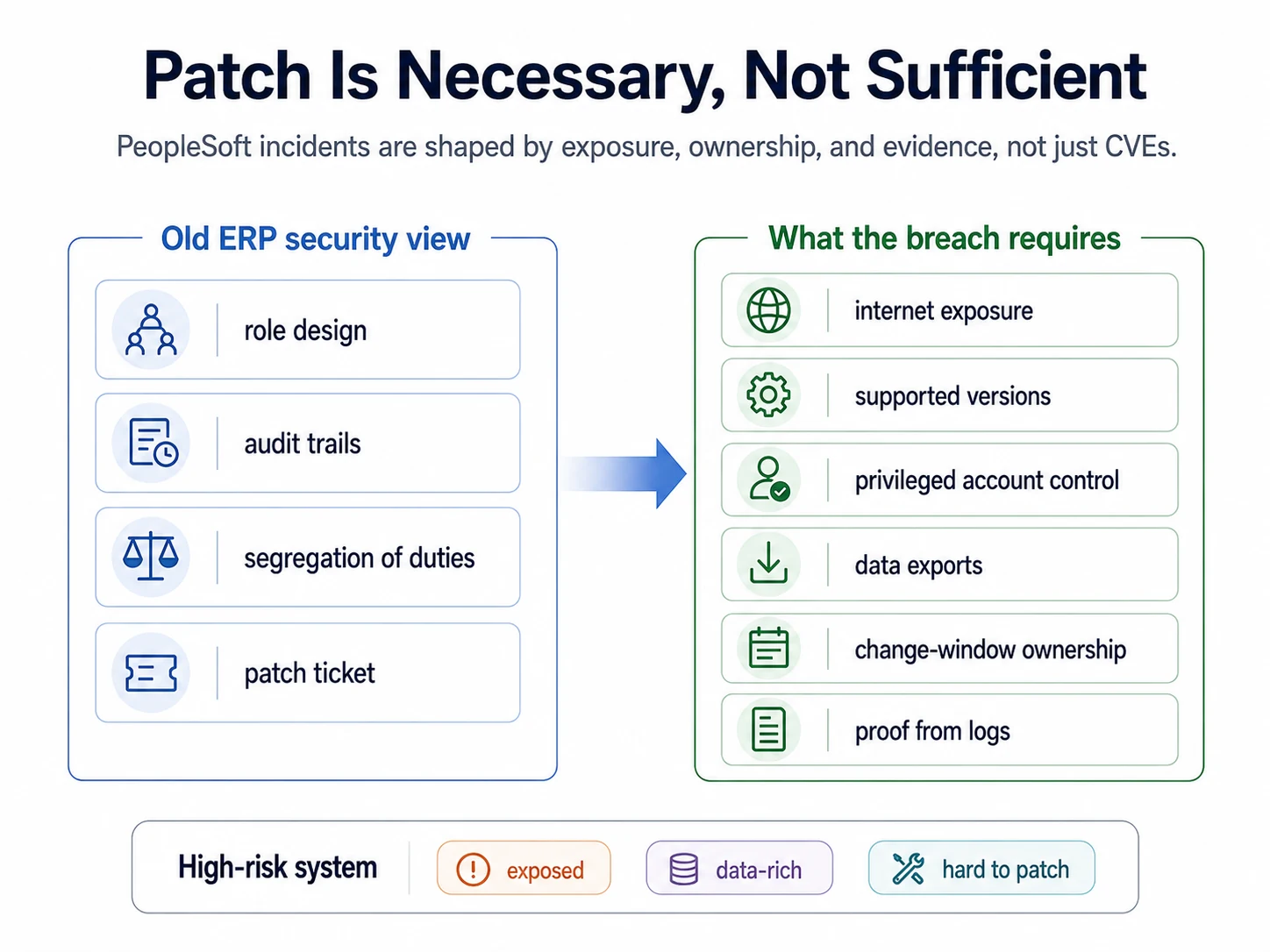
A vulnerability-management tool that only produces a CVE list is not enough for this class of system. The buyer needs asset ownership, public exposure, exploitability context, change-window coordination, application-owner workflow, privileged-account inventory, and proof that logs can answer the breach question. The question is not only whether the PeopleSoft stack is patched. The question is whether the organization can make and defend a fast decision when a campaign names PeopleSoft as the target.
That is a harder control than scan and patch.
It is also exactly where the market is moving after CISA's risk-based vulnerability management directive. The highest-risk queue is not defined by severity alone. It is defined by exposure, exploitation, automation, impact, ownership, and the ability to verify what happened.
PeopleSoft shows why the high-risk queue cannot be CVSS-only.
Systems-of-record defense is now its own problem
For vendors, the opportunity is not to create another generic breach dashboard. It is to defend systems of record as continuously exposed stores of extortion-grade data.
Exposure-management vendors should be able to identify every internet-facing ERP endpoint, portal, middleware tier, reverse proxy, VPN path, and administrative interface. Identity vendors should be able to show human and non-human access to the application, operating system, database, integrations, and support tooling. DSPM vendors should be able to map the sensitive data classes that live in and around the platform. SIEM and detection vendors should have deployable content for PeopleSoft web, application, database, SSH, proxy, and identity logs. Incident-response firms should have ERP-specific playbooks that do not treat the system like a generic Linux server.
The useful product joins exposure, privilege, data class, patch state, and telemetry into one response decision.
A CISO does not need five separate screens saying the same platform is important. The CISO needs to know whether the PeopleSoft environment is exposed, exploitable, overprivileged, missing patches, logging correctly, moving sensitive data into unmanaged stores, or already showing signs of compromise. The answer has to arrive before the extortion email does.
For founders, the product opening is specific. Systems of record are under-defended because they sit between application security, infrastructure security, identity, data security, and compliance. A product that can tell a CISO who owns the system, which path is exposed, which credentials matter, what data is at risk, and whether to isolate or keep running has a real budget owner. A product that only adds another inventory view will struggle.
For investors, the acquisition case is becoming easier to underwrite. ERP security will not stay a sleepy governance niche if extortion actors keep treating these platforms as scale targets. The adjacent winners may come from exposure management, identity governance, DSPM, application security, managed detection, or incident response. The common thread is data-rich operational software, not one vendor logo.
What buyers should do this week
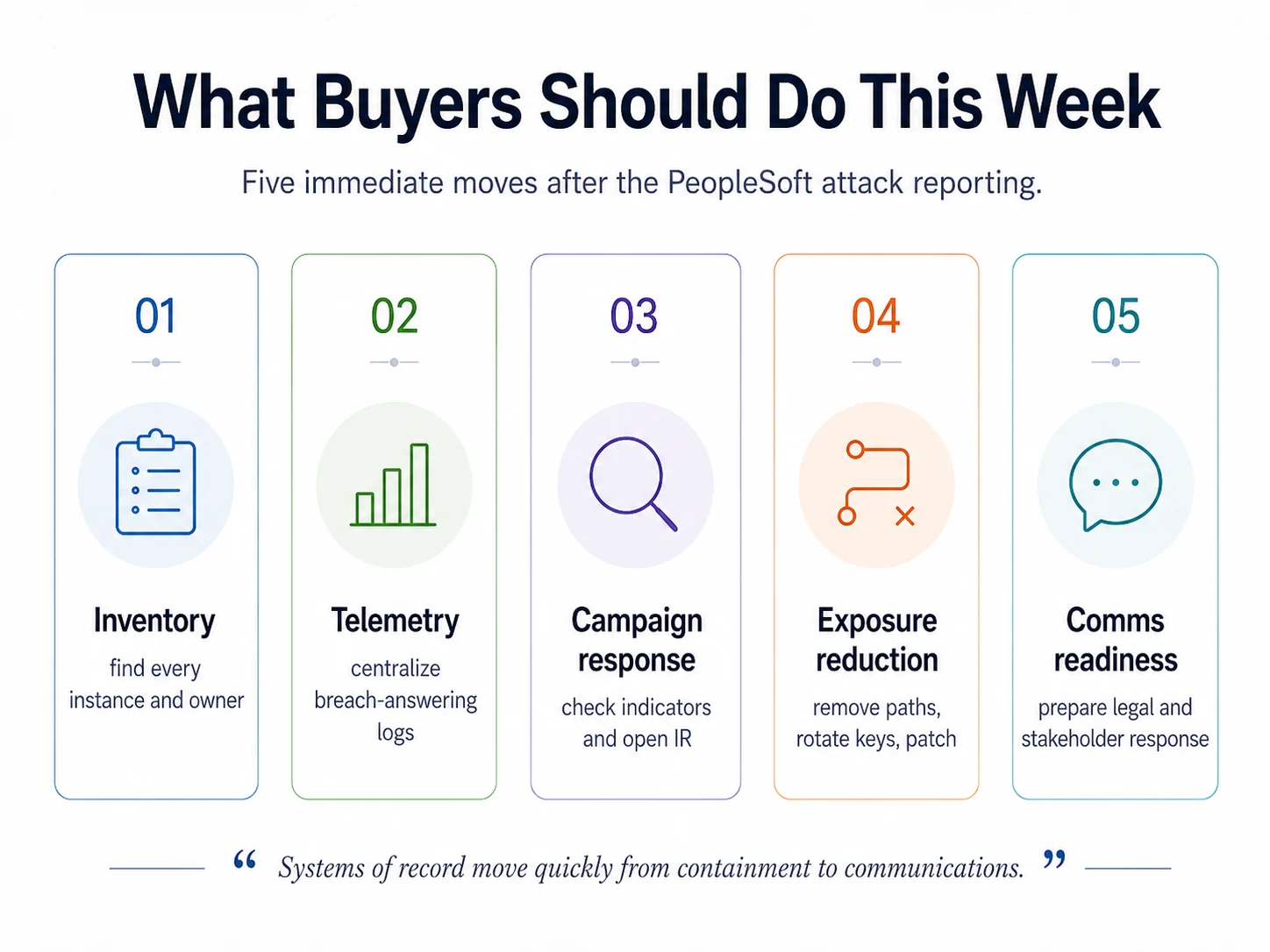
The first move is inventory.
Find every PeopleSoft instance, including production, disaster recovery, development, test, hosted, cloud, and forgotten departmental systems. Map internet exposure, remote access, reverse proxies, VPN dependencies, service accounts, administrative accounts, SSH keys, databases, file shares, data exports, and third-party operators. If the security team cannot name the owner and the exposure path, that is already a risk.
The second move is telemetry.
Centralize the logs that would answer a breach question: web requests, application logs, authentication events, SSH access, database access, privileged commands, file creation, outbound transfers, proxy logs, EDR events, and identity-provider events. Retention matters. Normalization matters. If the logs are only available on the server an attacker may have touched, the investigation starts behind.
The third move is campaign response.
Review the indicators listed in the public reporting, validate whether any related infrastructure touched the environment, and open an incident-response path if there are matches. Do not treat this as a normal patch cycle if indicators appear. The issue becomes whether data was accessed or exfiltrated, not only whether a vulnerable component exists.
The fourth move is exposure reduction.
Remove unnecessary internet paths, restrict administrative access, rotate high-risk credentials and keys where appropriate, confirm supported versions, apply relevant Oracle security updates, and document any risk acceptance where patching or isolation cannot happen quickly. Make exceptions explicit. Silent exceptions become breach debt.
The fifth move is communications readiness.
Systems-of-record incidents move quickly from technical containment to legal, regulatory, student, employee, supplier, and customer communications. The organization should know who owns notification, how scope will be validated, which data classes matter, and how to respond if individuals are contacted directly by an extortion actor.
This is the buyer lesson from PeopleSoft.
The threat is not that every ERP system will be breached tomorrow. The threat is that many organizations still protect systems of record as if their only failure mode is a bad audit finding. The ShinyHunters reporting points to a more direct failure mode: theft, pressure, impersonation, and public leakage.
ERP is no longer just where the business records transactions.
It is where attackers find names, accounts, payments, and pressure.
Frequently asked questions
- What is the Oracle PeopleSoft data breach story?
- As of June 11, 2026, the story is based on reporting that ShinyHunters claimed data theft from Oracle PeopleSoft instances at more than 100 organizations. BleepingComputer reported claims of 300 affected instances, and TechCrunch reported that many claimed targets were universities. Oracle had not responded in the cited reports, so buyers should treat the details as developing.
- Why does a PeopleSoft breach matter more than a normal application breach?
- PeopleSoft often manages systems-of-record data such as HR, payroll, finance, procurement, student administration, applicant records, fee payments, and internal administrative workflows. That kind of data gives attackers usable material for extortion, fraud, impersonation, regulatory exposure, and highly contextual spearphishing.
- What should PeopleSoft customers do after the ShinyHunters reporting?
- Customers should inventory all PeopleSoft instances, validate internet exposure, review the published indicators, centralize logs, check administrative access, confirm supported versions, apply relevant Oracle security updates, and begin incident response if indicators or suspicious activity are found. The question is not only whether a vulnerability exists, but whether data was accessed.
- Which cybersecurity categories are most relevant to PeopleSoft breach risk?
- Exposure management, identity security, privileged access management, DSPM, vulnerability management, SIEM, incident response, and third-party risk all matter. ERP security crosses too many control planes to be handled by one compliance checklist.
- What should buyers take from the PeopleSoft attacks?
- Systems of record are becoming extortion surfaces. Buyers should evaluate whether security vendors can connect public exposure, identity paths, sensitive data classes, patch state, telemetry, and incident-response workflow around ERP and other data-rich operational platforms.
Related on CyberBiz
- ShinyHunters and the Salesforce fabric breach — Earlier CyberBiz analysis on ShinyHunters, SaaS trust fabric, and business-platform breach pressure.
- CISA risk-based vulnerability management — How exposure, exploitability, impact, and ownership are replacing severity-only patch queues.
- Cybersecurity market map — Where exposure management, identity security, DSPM, and incident response sit in the broader cybersecurity market.
- Newsroom — Live cybersecurity market feed covering breaches, funding, M&A, products, and policy.
Sources
- Oracle PeopleSoft servers hacked in ShinyHunters data theft attacks — BleepingComputer
- Cybercriminals claim breach of Oracle PeopleSoft servers at 100-plus organizations — TechCrunch
- ShinyHunters: Cyber Criminal Group Attacks Learning Management System — FBI IC3
- University of Nottingham Data Breach — Have I Been Pwned
- Oracle Critical Patch Update Advisory - January 2026 — Oracle
Topics
Data Security and Protection · Incident Detection and Response · Identity and Access Management · Third-Party Risk Management · Governance, Risk, and Compliance
Written by
Tal Eliyahu
Editor at CyberBiz, covering cybersecurity vendors, M&A, and platform shifts.