AI Email Security Funding: Ocean's $28M Checkpoint Bet
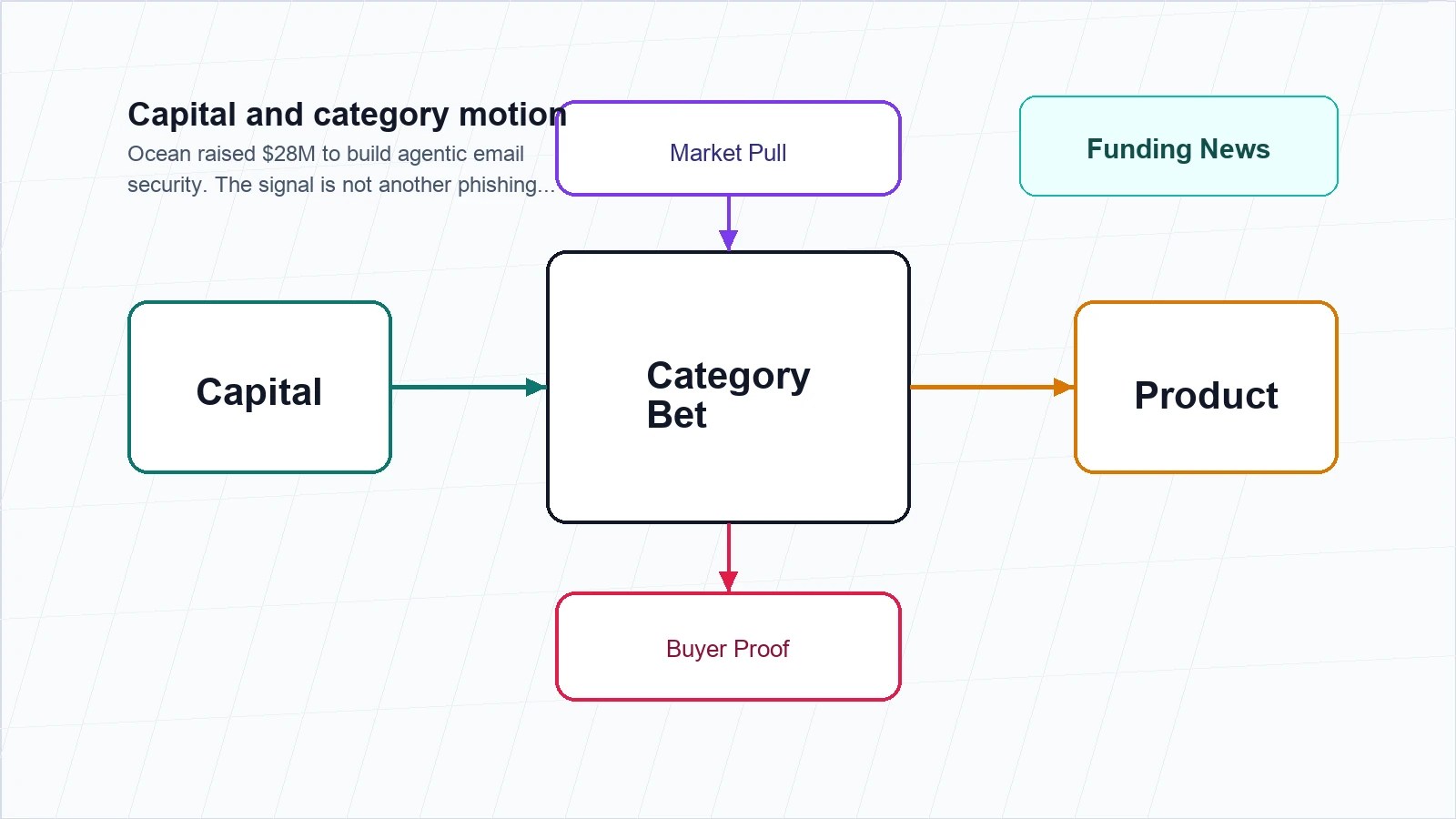
Ocean raised $28M to build agentic email security. The signal is not another phishing tool. It is a bet that every inbox needs a checkpoint.
By Tal Eliyahu · · 8 min read
The inbox is becoming a checkpoint.
Not a mailbox. Not a productivity surface. A checkpoint.
Ocean's $28 million launch from stealth is easy to read as another AI-security funding round. That is the lazy read. The more interesting signal is that investors are now funding email security companies built around autonomous investigation, not better detection filters.
Many people will see this as a phishing story. I see it differently. Phishing is the symptom. The category question is whether email security moves from scanning messages to inspecting intent at the point of entry.
Ocean is funding the inspection lane
Ocean announced its launch from stealth on May 19, 2026 with $28 million in total funding. Lightspeed Venture Partners led the financing, with participation from Picture Capital and Cerca Partners. The angel list is also telling: Assaf Rappaport from Wiz, Armis co-founders Yevgeny Dibrov and Nadir Izrael, and Dor Knafo from Axis Security / Cyberstarts were included in the announcement.
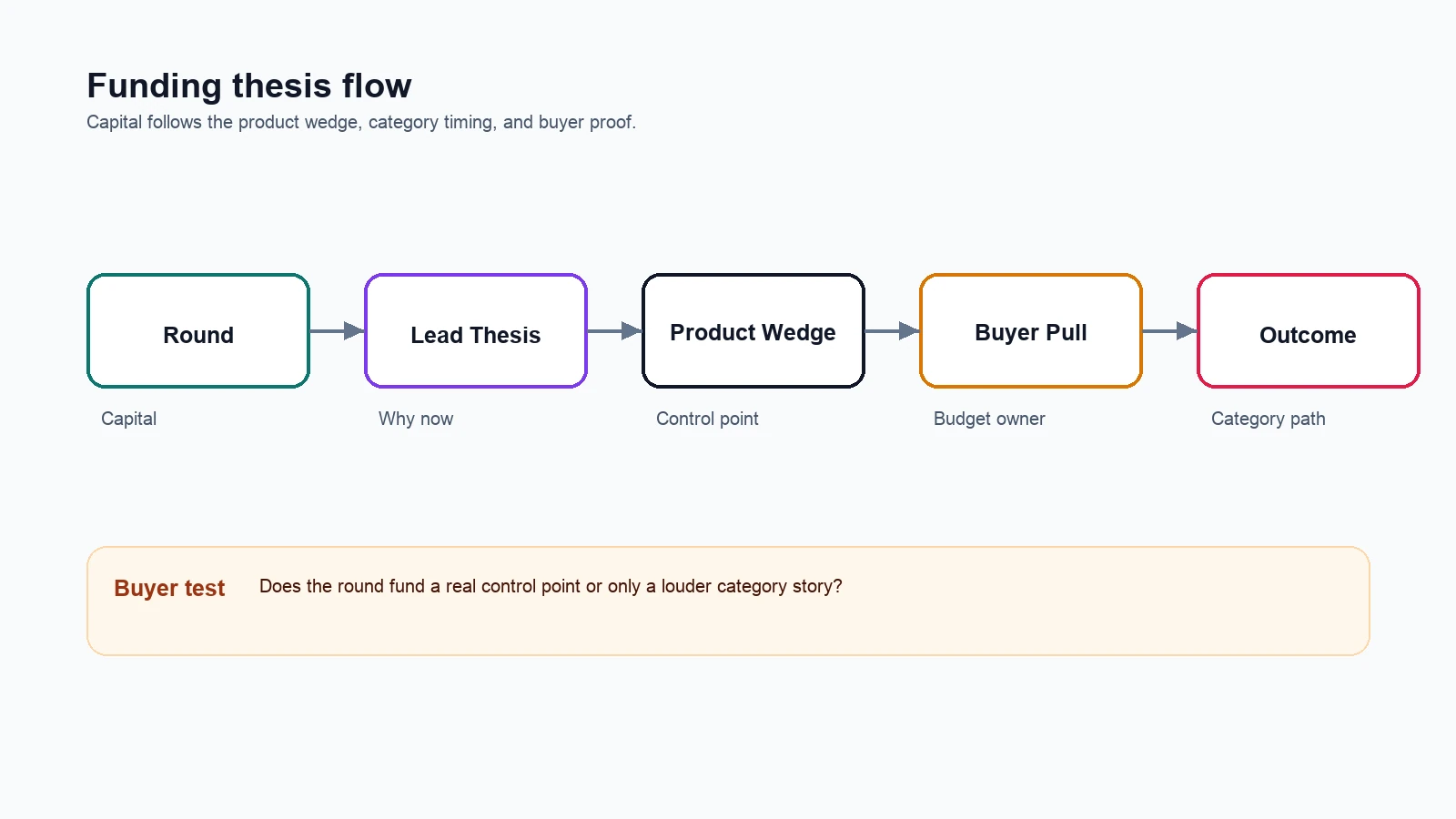
CTech adds useful structure to the headline number: Ocean raised a $20 million Series A, after an $8 million seed round in 2024. That distinction matters because the company is not just announcing capital. It is announcing the sequence: seed the product, show early enterprise traction, then launch publicly into a category that already has well-capitalized incumbents.
The product claim is straightforward. Ocean says its agents investigate every email in real time, checking sender identity, message content, links, infrastructure, and business context before deciding whether the message can be trusted. On its own site, Ocean frames the product around going deeper than surface patterns and treating each message like an investigation, not an object to be scored.
That framing is the whole story.
The old email-security model was an airport metal detector. Does the message contain the object we know to be dangerous? Is the sender on a bad list? Does the link look malicious? Does the attachment match a signature? This worked reasonably well when attackers needed reusable templates, visible infrastructure, and enough repetition to create patterns.
AI changes the attacker's economics. The message can be unique. The sender context can be researched. The language can be clean. The request can reference a real business process. A metal detector is less useful when the weapon is the story.
Ocean is betting the checkpoint has to become an interview.
The funding signal is not the size
$28 million is not a category-defining number by 2026 cybersecurity standards. We have already seen much larger agentic-security rounds: XBOW's strategic extension, 7AI's massive agentic SOC Series A, and the broader funding concentration around autonomous defense. Even in email security, Abnormal Security is operating at a different scale after its $250 million Series D at a $5.1 billion valuation.
The interesting part is the stage and the wedge.
Ocean is not saying enterprises need one more secure email gateway. It is saying the unit of analysis has changed. The relevant question is no longer whether an email contains a known-bad indicator. The relevant question is whether the email's intent makes sense inside a specific company, for a specific employee, at a specific moment.
That is a much harder product. It is also a much bigger claim.
Many email-security products already use AI. Proofpoint, Mimecast, Microsoft, Abnormal, and others all have machine learning, behavioral models, or AI workflows somewhere in the stack. The difference in Ocean's positioning is not the presence of AI. The difference is that Ocean is selling autonomous investigation as the product primitive.
That matters for investors. A filter is a feature. An investigation layer can become a platform.
The checkpoint moved from content to context
Microsoft's Q1 2026 email-threat data shows why this shift is happening now. Microsoft Threat Intelligence said it detected approximately 8.3 billion email-based phishing threats in the quarter. Link-based threats made up most of the volume, QR-code phishing more than doubled across the quarter, and CAPTCHA-gated phishing surged in March.
Those are not all AI-generated attacks. They do not need to be. The point is that the delivery surface is fragmenting while the attacker's ability to customize messages is improving.
Abnormal AI's 2026 Attack Landscape Report makes the same point from a different angle. The company reported that phishing accounted for 58% of observed attacks in its dataset, and that 21.6% of phishing attacks used redirect chains to hide destinations and evade legacy controls. The report was based on activity across more than 4,600 organizations in the second half of 2025.
The pattern is not subtle. Attackers are hiding less in bad grammar and more in normal workflow. Vendor payments. Shared documents. Internal replies. Student inboxes. Executive requests. QR codes. CAPTCHA flows. Redirect chains. The message looks less like malware and more like work.
That is why context matters.
A content filter asks whether the email looks suspicious. A context-aware checkpoint asks whether this sender, this request, this link, this timing, and this relationship belong together. That is the market Ocean wants to enter.
The distinction sounds small until you price it.
Content filtering is a mature procurement category. Context investigation is a budget-expansion argument. If Ocean can prove it, the buyer is not just replacing a gateway. The buyer is moving part of the SOC's investigative workload into the inbox.
Abnormal is the real comparable, not Proofpoint
The conventional comparison is Proofpoint and Mimecast. That makes sense at the product-shelf level. Email security budgets live there. Renewal calendars live there. Procurement knows the category.
But the strategic comparable is Abnormal.
Abnormal's rise showed that the email-security market was willing to pay for behavioral understanding, API-native deployment, and protection beyond classic inbound-message scanning. Its 2024 financing put the company at a $5.1 billion valuation, with more than $200 million in ARR disclosed in the announcement. That is the comp table investors are reading when they look at Ocean.
Ocean's pitch is narrower and earlier. It is also more explicitly agentic. The company is saying: the next version of email security is not just behavior analysis. It is an always-on investigation system where agents collect evidence, judge intent, triage reports, and reduce human review.
That is the correct bull case.
The bear case is also obvious. Email security is crowded, sticky, and procurement-conservative. Buyers already run Microsoft Defender, Google-native controls, Proofpoint, Mimecast, Abnormal, or some combination of them. Replacing a core email-security layer is not like adding a dashboard. It touches productivity, legal hold, compliance, incident response, user trust, and the executive inbox.
Ocean has to prove two things at once. It has to prove efficacy against attacks that old tools miss. It also has to prove operational trust, meaning the product can investigate at high volume without creating noisy blocks, strange employee experiences, or SOC workflows that security teams quietly route around.
That second proof is harder.
The investor list is a category map
The cap table is useful because it points to where the category may go.
Lightspeed leading the round says this is being priced as a venture-scale software infrastructure problem, not a niche phishing tool. Picture Capital's involvement matters because Mike Fey and Dan Amiga built Island around enterprise browser control, another category where security moves closer to the point where work happens. Angel participation from Wiz and Armis founders adds a familiar 2026 signal: operators who built platform-scale cybersecurity companies are placing checks near agentic control points.
Email is one of those control points.
We have been watching the agentic stack consolidate from multiple directions. Cisco's Astrix deal put non-human identity closer to the platform layer. Palo Alto's Portkey acquisition moved the AI gateway into a major security platform. XBOW's round showed autonomous offensive security pulling strategic capital. Cloudsmith's round framed the software artifact registry as the checkpoint for autonomous publishers.
Ocean adds the inbox to the same map.
That does not mean Ocean becomes the winner. It means the agentic-security capital cycle is expanding from obvious AI surfaces into old control planes that suddenly look under-instrumented. Email is old. The problem is not.
Buyers should watch the false-positive economics
The next twelve months for Ocean come down to false-positive economics.
Every email-security startup claims it can stop what others miss. The harder question is what the product costs the organization when it is wrong. A false negative is obvious: the attack lands. A false positive is quieter but still expensive: a deal stalls, a finance process breaks, a VIP loses trust, or the SOC starts ignoring the tool.
Autonomous investigation raises that bar. If agents are going to make high-speed decisions in the inbox, buyers need evidence that the system can explain itself, recover from mistakes, and adapt to the company's real workflows. The best product in this category will not be the one that says AI most loudly. It will be the one that makes the checkpoint feel boring.
Boring is the target.
For founders, Ocean's round is a reminder that the AI-security funding wave is not limited to brand-new categories. Sometimes the better funding wedge is an old category whose operating model no longer matches the attacker's economics.
For investors, the question is whether the agentic-email layer becomes standalone, gets bought by incumbents, or gets absorbed into Microsoft and Google native controls. All three outcomes are plausible. The useful signal is that capital is now paying for the standalone version before the platform answer is settled.
Ocean's round is not about another phishing detector. It is about who controls the checkpoint.
The inbox used to be where work arrived. Now it is where trust gets inspected.
Frequently asked questions
- What is Ocean Security?
- Ocean Security is an agentic email security startup founded in 2024 by Shay Shwartz and Oran Moyal. The company says its platform uses AI agents to investigate every email in real time, analyzing sender identity, message content, links, infrastructure, and business context before deciding whether a message can be trusted.
- How much funding did Ocean raise?
- Ocean announced $28 million in total funding on May 19, 2026. CTech reports the new round as a $20 million Series A led by Lightspeed Venture Partners, following an $8 million seed round in 2024. The distinction matters because the headline number is total funding, not only the new Series A.
- Why does AI email security funding matter?
- AI email security funding matters because attackers can now customize phishing and business-email-compromise messages at a scale that weakens surface-level detection. Investors are funding products that understand intent, context, and workflow rather than products that only score static indicators. That changes both the product architecture and the valuation comparable set.
- Who are Ocean's main competitors?
- Ocean competes in a market that includes established email security vendors such as Proofpoint and Mimecast, native platform controls from Microsoft and Google, and AI-native behavioral security vendors such as Abnormal Security. The strategic comparison is especially close to Abnormal because both companies frame email security around behavior and context rather than classic gateway filtering alone.
Related on CyberBiz
- Cybersecurity market map — Where email security and agentic security sit in the broader cybersecurity vendor landscape.
- Newsroom — Live cybersecurity market feed covering funding rounds, M&A, product launches, and incidents.
- Cybersecurity funding signals framework — How to read cap tables, stage compression, strategic checks, and category signals in 2026 funding rounds.
- XBOW strategic-only round analysis — Companion analysis on agentic-security capital and why round structure matters more than headline size.
Sources
- Ocean Raises $28M as Enterprises Confront a New Wave of AI-Powered Email Attacks — Ocean Security / GlobeNewswire
- Ocean Security — Ocean Security
- From teen hacker to Iron Dome researcher, this founder raised $28M to fight AI phishing — TechCrunch
- Ocean raises $20 million Series A to tackle AI-driven email attacks — CTech
- 7AI Raises Largest Cybersecurity A Round in History — 7AI / Business Wire
- Email threat landscape: Q1 2026 trends and insights — Microsoft Security Blog
- Abnormal AI 2026 Attack Landscape Report announcement — Abnormal AI / Business Wire
- Abnormal Security Announces $250 Million Series D Financing — Abnormal Security / Business Wire
Topics
Email Security · AI Security, Governance and Assurance · Threat Intelligence · Incident Detection and Response
Written by
Tal Eliyahu
Editor at CyberBiz, covering cybersecurity vendors, M&A, and platform shifts.