How to Read Cybersecurity Funding Signals: A 2026 Framework
The cybersecurity funding round most worth reading is rarely the one with the biggest headline number. A framework for reading 2026's signals.
By Tal Eliyahu · · 13 min read
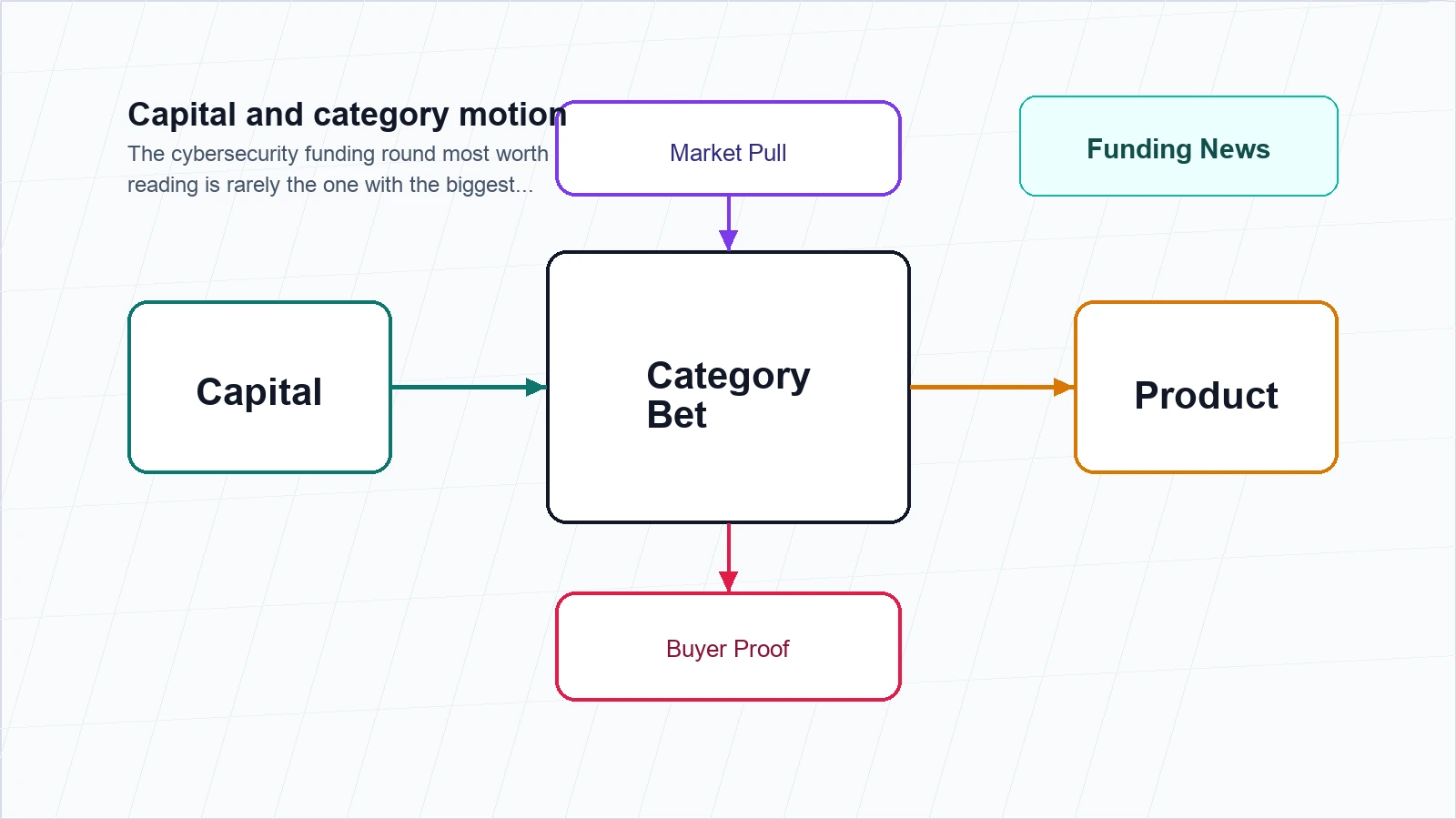
The cybersecurity funding round most worth reading is rarely the one with the biggest headline number.
The number is the noisy signal. The structure is the clean one.
In the past four months, cyber-biz.com has analyzed three rounds across three different structural shapes — XBOW's strategic-only Series C extension, Cloudsmith's TCV-led Series C, and the broader cybersecurity M&A landscape the platforms are drawing. Each round told a different forward signal. Each forward signal predicted a different downstream event.
This piece is a framework for reading those signals — what each component of a round actually says about the company, the category, and the M&A landscape three to eighteen months ahead. It is a structured way to look at the cybersecurity funding cycle of 2026, applicable to whichever round announcement crosses your desk next.
The cap table is a leading indicator
The dollar amount is the press-release headline. The cap table is the actual signal.
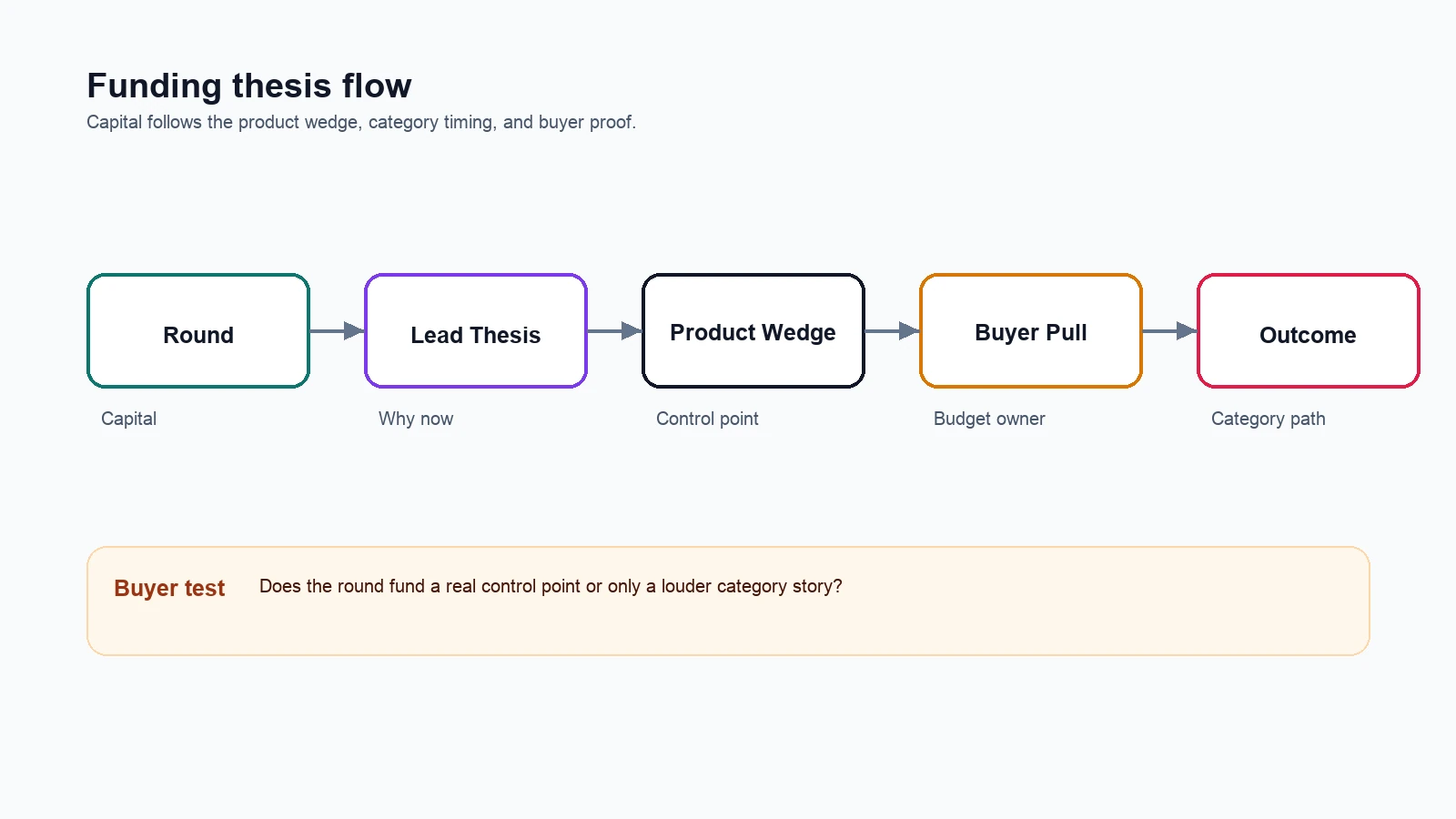
For any cybersecurity Series B and later round, four cap-table shapes predict different downstream outcomes.
Tier-one financial lead with strategic participation. The standard structure. The lead VC prices the round, signals validation, and brings the network. Strategics fill the remaining capacity. This shape is the default and tells you the company has a credible thesis-stage investor base. It says little about acquisition timing.
Strategic-only. No financial lead. The round comes entirely from customers, partners, distribution channels, and prospective acquirers. This shape is rare and high-signal. It indicates the product has crossed from experimental to enterprise procurement, and that strategics are paying for roadmap influence on a product they already depend on. XBOW's $35 million extension in May, anchored by NVIDIA, Samsung, Accenture, and SentinelOne, is the cleanest 2026 example.
Generalist growth fund lead. A non-cybersecurity-specialist fund leads the round. TCV, Tiger Global, Coatue, ICONIQ, Stripes — the firms that built positions in Spotify, Netflix, Airbnb, Splunk's pre-IPO. Cloudsmith's $72 million Series C in April is the 2026 marker. This shape signals the category is graduating from niche cybersecurity bet to mainstream software infrastructure investing.
Sovereign or regional capital lead. A geographically anchored fund (UK, European, Israeli, Indian, sovereign wealth) leads. The buyer base reading the round is procurement teams in that region's regulated sectors and government-adjacent enterprises. Sitehop's UK-anchored cap table (Northern Gritstone, Amadeus, Mercia, NPIF) fits this pattern.
Each shape predicts a different acquirer set, a different valuation comp, and a different time-to-exit. Knowing which one you are reading is the first analytical move.
Strategic-only rounds rehearse acquisitions
Strategic-only rounds are the highest-signal cap-table shape in 2026 cybersecurity.
The historical conversion pattern is consistent. When a public security vendor writes a strategic check into a private cybersecurity company at meaningful scale, the position has converted to a full acquisition within roughly 18 months at a non-trivial rate. The check is the rehearsal. The acquisition is the show.
The mechanism is straightforward. A strategic investment locks in commercial relationships, gives the public vendor visibility into roadmap, and creates an option to convert the position into ownership. Compared to building the capability internally, acquiring after a strategic-investment period is faster, lower-risk, and pre-validated by customer commercial use. Compared to acquiring cold, post-investment acquisition has integration paths and customer references already in place.
The pattern repeats with NVIDIA. NVIDIA NVentures has investments across cloud security, MLOps, and observability companies that NVIDIA does not need for distribution but does need for runtime visibility into where AI workloads run. The investments are GPU-consumption rehearsals as much as capability-acquisition rehearsals.
For public security companies — CrowdStrike, Palo Alto Networks, SentinelOne, Cisco — the venture arm is functionally a deal-pipeline tool. Investors and corp-dev teams reading these rounds should map the strategic positions of public security vendors specifically. The next twelve to eighteen months of M&A is partly visible in the cap tables of today.
What the strategic-only round does not tell you is which of the public investors will be the eventual acquirer. Multiple strategics in the same cap table can signal a competitive M&A process — or a coordinated decision to keep the company independent until the category resolves. Reading which is which requires reading the strategic positioning of each investor in adjacent categories.
Generalist growth funds signal category graduation
When a generalist software growth fund leads a cybersecurity round, the signal is not about the company. It is about the category.
Generalist growth funds — TCV, Tiger Global, Coatue, ICONIQ, Stripes, Insight Partners on the larger end of its book — invest across software infrastructure broadly. Their portfolio comparables are companies like Snowflake, MongoDB, HashiCorp, Splunk, GitHub, JFrog, and the rest of the developer-tooling and enterprise-infrastructure cohort. When one of these funds leads a cybersecurity Series C, the firm is benchmarking the company against that comparable set, not against pure-play cybersecurity Series C rounds.
That changes three things at once.
The valuation comp resets. Generalist growth funds price against software-infrastructure multiples, which are higher than pure-play cybersecurity multiples for companies of comparable scale. Cybersecurity companies that close generalist-led rounds get re-priced upward.
The acquirer base widens. The natural acquirers for a software-infrastructure company include developer-tooling platforms (GitHub / Microsoft, GitLab, JFrog, HashiCorp / IBM), workflow platforms (ServiceNow, Atlassian, Salesforce), and the broad enterprise-infrastructure cohort. Pure-play cybersecurity acquirers are still in the set; they are no longer the only option.
The procurement narrative shifts. Cybersecurity sold by generalist-funded companies tends to be sold as software infrastructure with security implications, rather than as cybersecurity products with software implications. The buyer base is platform engineering and engineering leadership, not just CISOs.
Cloudsmith's TCV-led Series C is the cleanest 2026 example. The round positions Cloudsmith for software-infrastructure comparable pricing rather than pure-play cybersecurity multiples. The acquirer base now plausibly includes JFrog, HashiCorp, GitHub, ServiceNow, and Snyk. The procurement narrative is software supply chain, not cybersecurity SaaS.
For founders, the strategic implication is that pitching a generalist fund requires a different deck and a different comparable set than pitching a cybersecurity-specialist fund. The companies that prepare for both audiences see broader investor sets and better pricing. The ones that prepare for only one see the round priced like the audience they pitched.
Comparable deal pricing is the only honest valuation comp
The most over-cited number in cybersecurity funding analysis is the public-company multiple. The most under-cited is the strategic-acquisition multiple.
For 2026 cybersecurity Series A through Series E rounds, the relevant comparables are not Palo Alto Networks' EV/Revenue or CrowdStrike's price-to-sales. The relevant comparables are: what did the platform vendors pay for the last three acquisitions in this category, and at what revenue and growth profile.
Capstone Partners' Q1 2026 cybersecurity update reports an average EV/Revenue multiple of 4.3x across 79 verified strategic transactions in YTD 2026 — on par with the eight-year sector average of 4.6x, not the 2021-2022 froth. ION/Mergermarket clusters strategic deal discussions at 6-8x ARR, with 8-10x reserved for the most strategic targets. Average ticket size up to $461 million from $171 million year over year, driven by mix toward larger strategic deals.
Those numbers anchor the actual cybersecurity funding economics in 2026. They are the comp set Series C and later rounds should be priced against.
The distinction matters because public-comp pricing tends to compress acquisition exits and inflate ongoing-business valuations, while strategic-acquisition comp pricing does the opposite. A category where strategic acquirers are paying 8-10x ARR for the leader has very different funding economics than a category where strategic acquirers cap at 5x ARR.
For cybersecurity venture investors, the practical implication is to maintain category-specific strategic-acquisition comp tables, not just public-comp benchmarks. The categories where strategic acquirers are paying premium are the categories where venture-stage investments can be priced richly. The categories where strategic acquirers cap at sector-average are the categories where venture-stage discipline matters more.
For founders raising in 2026, the implication is to know the strategic-acquisition comp pricing for your specific category before walking into a financing conversation. The funds that price your round will know it. The funds that don't will be the ones you don't want leading.
Public-vendor venture investments are soft M&A signals
Strategic investments by public cybersecurity vendors warrant their own analytical line item.
CrowdStrike's S Ventures, Palo Alto Networks' venture arm, SentinelOne's S Ventures, Cisco's investments, Microsoft's M12, Okta Ventures, and a handful of others run as quasi-acquisition pipelines. The investments are real venture bets, but the strategic intent runs through the corporate development team, not just the venture team.
The historical pattern: a strategic investment from a public security vendor into a category-adjacent private company, at meaningful check size and at later than seed stage, has historically converted to M&A inside 18 months at a non-trivial rate.
What to read in the round: which public vendor is in the cap table, at what scale, and into which category. Multiple public-vendor investments in the same cap table can signal a coordinated decision to maintain optionality, or a competitive M&A process forming early. Reading which is which requires understanding each public vendor's adjacent acquisitions and stated strategic priorities.
For M&A and corp-dev teams at competing platforms, public-vendor venture investments are the leading indicator that should drive their own pipeline review. If PANW wrote a strategic check into a private agent-aware DLP company in Q2 2026, the corp-dev teams at Cisco, CrowdStrike, and Microsoft should be paying particular attention to the rest of that category by Q4. The vendor that closes the acquisition first sets the comparable price for the rest.
For cybersecurity venture investors, the practical implication is to follow public-vendor venture activity as a category-formation signal. The categories where multiple public vendors are writing checks are the categories where the platforms have decided the layer matters. The categories where no public vendors are present are categories where venture-stage thesis still has to do the work.
Geography signals procurement preferences
The cap table tells you who is investing. The geography of the cap table tells you who is buying.
In 2026 specifically, geographic signature predicts procurement preferences in ways US-centric coverage tends to miss.
UK and European-anchored cap tables (Sitehop's Northern Gritstone, Amadeus, Mercia; the broader European deep-tech cohort) signal positioning toward European, UK, and allied-government procurement. As federal cyber capacity in the US has come under strain, allied governments and critical-infrastructure operators in the EU, UK, and parts of Asia have become increasingly unwilling to accept US-only stacks at sensitive layers. Cap tables anchored in those geographies position the company to win that procurement preference. Sitehop's UK cap table is doing exactly this work in the PQC silicon category.
Israeli cap tables (Cyberstarts, YL Ventures, Team8, Glilot, Insight Partners' Israel positions) signal positioning toward US enterprise procurement combined with Israeli technical talent supply. The 2026 M&A wave has Israeli targets disproportionately represented — Wiz, CyberArk, Astrix, Koi, Portkey, Cyata, Cyclops, Rotate, Fabrix, and Seraphic. The Israeli supply curve for agentic-identity and AI-security is structurally important and continues to set the pace.
Indian cap tables — still rare in cybersecurity — signal positioning toward Asian enterprise procurement and the global services market.
US cap tables remain the default. They signal nothing in particular beyond what the specific firms in the cap table tell you.
For procurement teams in regulated sectors, especially those headquartered outside the US, the geographic signature of a vendor's cap table is increasingly a procurement input. For founders raising in 2026, the implication is that geographic positioning should be intentional — neither default nor accidental.
Stage compression is the 2026 pattern
One pattern cuts across every other signal in the 2026 cybersecurity funding cycle. Stage compression.
Series A check sizes have grown materially. 7AI's $130 million Series A for agentic SOC, Artemis's $70 million Series A for AI-vs-AI defense, and the broader cohort of large 2026 Series A rounds in agentic-security categories sit well above the $20-40 million range that defined cybersecurity Series A through 2023. The compression is real and category-specific.
The mechanism is the same one driving the agentic security category map: the platform vendors are buying earlier, smaller, and faster than they did in the prior cycle. They learned from cloud security that the cost of being late is paying $25 billion or $32 billion to a category leader. To prevent the next Wiz from emerging, they are acquiring before the category leader is established — which forces venture investors to price earlier-stage rounds at premium multiples to capture position before the platforms move.
The practical implication for venture investors is that the window between Series A and acquisition has compressed for the agentic-security categories specifically. The window in less-active categories has not. Reading which window applies to which round is the analytical work.
For founders, the implication is that the runway between independent operation and acquisition pressure is shorter than it was in the prior cycle. Series B and later rounds in agentic categories should be planned with the assumption that platform-vendor M&A interest will arrive within twelve to eighteen months of the Series B close. Founders who want a longer runway should price their next round and structure their cap table for that specific outcome.
For procurement teams, the implication is procurement-side acquisition risk. Buying from an independent leader in any of the contested agentic layers carries meaningful probability that the vendor is acquired before the next renewal. That should be priced into the contract.
What the round announcement does not say
The press release tells you what the company wants the market to read. The structural signal often lives in what the press release does not say.
Four absences are worth reading.
Undisclosed valuation. A round closes without a stated valuation. Sometimes this is a flat or down round being soft-pedaled. Sometimes it is a strategic round where the strategic investors do not want the price benchmarked publicly. Sometimes it is a fast follow-on at improvised pricing. The interpretation depends on the rest of the cap-table signal — but valuations get disclosed when they are flattering, and stay quiet when they are not.
Undisclosed lead investor. A round announces strategic participants without naming a lead. This pattern signals either a strategic-only round (no financial lead) or a discount-priced round where the lead does not want the round associated with their public partner. Either way, the absence is signal.
Vague participation language. *Significant participation*, *follow-on investment*, *expanded position* — language that obscures whether the named investor wrote a meaningful new check or rolled an existing position. The press-release language tells you who wanted to be named on the announcement; the actual money distribution is harder to read.
Who is not in the round. The obvious specialist fund that did not lead. The obvious strategic acquirer that did not invest. The prior-round lead that did not follow on. Each absence carries its own signal — and each is harder to read than the presence signals.
Reading absences requires knowing the universe of plausible investors and acquirers for the category. Investors and corp-dev teams that maintain that knowledge are the ones who consistently read funding signals well. The ones that do not are the ones who notice the patterns only after the press release has stopped surfacing in the news cycle.
The round announcement is a curated artifact. The structural signal is the diff between the announcement and what the announcement could have said.
How to read the next round you see
Apply the framework in order. Cap-table composition first. Comparable pricing second. Public-vendor presence third. Geographic signature fourth. Stage compression fifth. Absences sixth.
Most rounds tell a clear story when read against all six dimensions. The minority that do not are usually the ones worth a second pass.
Frameworks are not predictions. They are the discipline of reading signals consistently rather than chasing headline numbers.
The cybersecurity funding cycle of 2026 has produced more readable signals than any prior cycle. The investors and founders who read them well will spend less time guessing what the platforms will buy, and more time building or backing the companies the platforms have to buy.
Frequently asked questions
- How do I tell a strategic-only round from a typical strategic-led round?
- A typical round has a tier-one financial lead investor that prices the round and brings the network, with strategics filling the remaining capacity. A strategic-only round has no financial lead at all — every dollar comes from a customer, partner, distribution channel, or prospective acquirer. The signal flips from thesis-stage validation to enterprise procurement validation. XBOW's $35 million Series C extension in May 2026, anchored by NVIDIA, Samsung, Accenture, and SentinelOne with no traditional VC lead, is the cleanest 2026 example. Strategic-only rounds historically convert to acquisition within roughly 18 months at non-trivial rates.
- What does it mean when a generalist growth fund leads a cybersecurity round?
- When TCV, Tiger Global, Coatue, ICONIQ, Stripes, or Insight Partners' larger book leads a cybersecurity Series C — instead of a Cyberstarts, Greylock, or Sequoia — the category is graduating from niche cybersecurity bet to mainstream software infrastructure investing. Three things change: the valuation comp resets to software-infrastructure multiples (which are typically higher than pure-play cybersecurity for comparable scale), the acquirer base widens to include developer-tooling and workflow platforms (GitHub, ServiceNow, Atlassian) alongside cybersecurity-specialist acquirers, and the procurement narrative shifts from *cybersecurity SaaS* to *software infrastructure with security implications*. Cloudsmith's TCV-led $72 million Series C in April 2026 is the cleanest 2026 marker.
- How should a cybersecurity Series C be priced in 2026?
- Against strategic-acquisition comparables for the specific sub-category, not against public-company multiples. Capstone Partners reports 4.3x EV/Revenue average across YTD 2026 strategic transactions. ION/Mergermarket clusters strategic deal discussions at 6-8x ARR, with 8-10x reserved for the most strategic targets. Average ticket size has risen to $461 million from $171 million year over year, driven by mix toward larger strategic deals. The categories where strategic acquirers are paying 8-10x ARR are the categories where venture-stage investments can be priced richly. The categories where strategic acquirers cap at sector-average require more pricing discipline.
- What 2026-specific patterns should investors and founders prepare for?
- Three. First, stage compression — Series A check sizes in agentic-security categories sit well above prior-cycle norms (7AI $130M, Artemis $70M), and the window between Series A and acquisition has compressed to 12-18 months. Second, public-vendor venture activity as soft M&A signal — strategic checks from CrowdStrike, Palo Alto, Cisco, SentinelOne convert to M&A at non-trivial rates inside that window. Third, geographic signature as procurement signal — UK and European cap tables position for allied-government and EU procurement at the moment US federal cyber capacity is under strain; Israeli cap tables remain the dominant supply curve for agentic-identity and AI-security categories.
Related on CyberBiz
- Cybersecurity market map — Where each cybersecurity sub-category and its venture-funded leaders sit in the broader vendor landscape.
- Public cybersecurity companies — The public security platforms whose venture arms (CrowdStrike S Ventures, PANW, Cisco, SentinelOne) are leading-indicator signals for the next eighteen months of M&A.
- XBOW strategic-round analysis — The cleanest 2026 example of the strategic-only round structure.
- Cloudsmith generalist-fund analysis — The cleanest 2026 example of generalist-growth-fund-led category graduation.
- Sitehop sovereign-crypto analysis — The cleanest 2026 example of geographic signature predicting allied-government procurement preference.
- Cybersecurity M&A 2026 pillar — Companion pillar piece on the M&A activity drawing the same map.
- Agentic security category map pillar — Companion pillar piece on the agentic-stack categories where capital is concentrating.
- Newsroom — Live cybersecurity market feed: funding rounds, M&A, and product launches.
Sources
- Capstone Partners Q1 2026 Cybersecurity Market Update — Capstone Partners
- Cybersecurity M&A stalls after 2025 surge as AI resets valuations — ION Analytics / Mergermarket
- Q1 2026 cybersecurity M&A consolidation analysis — Tech Insider
- Cybersecurity Funding Surges to $4.62B in Q1 2026 — Pinpoint Search Group / PR Newswire
- SecurityWeek 2025 Cybersecurity M&A Report (baseline) — SecurityWeek
Topics
AI Security, Governance and Assurance · Identity and Access Management · Third-Party Risk Management · Governance, Risk, and Compliance
Written by
Tal Eliyahu
Editor at CyberBiz, covering cybersecurity vendors, M&A, and platform shifts.